

The National Eligibility cum Entrance Test (NEET) is the gateway to admission into MBBS, BDS, AYUSH, and several other medical courses across India. Every year, millions of students compete for limited seats in prestigious medical colleges, making NEET one of the most challenging entrance examinations in the country.
A thorough understanding of the NEET Syllabus is one of the most important factors for success. Many students spend countless hours studying, but without knowing exactly what topics are included in the exam, their efforts may not produce the desired results.
This comprehensive guide covers the complete NEET Syllabus, subject-wise topics, preparation strategies, exam pattern, and expert tips to help aspirants prepare effectively.
What is the NEET Syllabus?
The NEET Syllabus is a structured list of topics prescribed for the NEET examination. It primarily includes concepts from Classes 11 and 12 in Physics, Chemistry, and Biology.
The syllabus is designed to evaluate a student’s understanding of scientific concepts, analytical abilities, and application skills necessary for medical education.
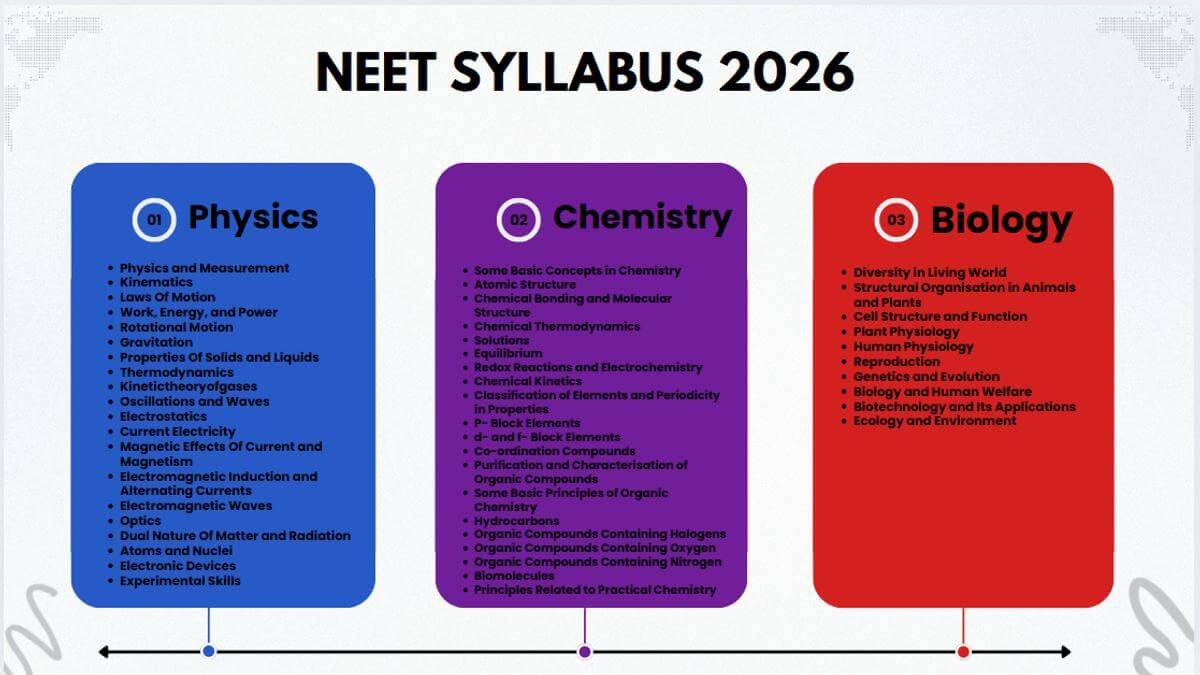
Understanding the syllabus allows students to:
- Focus on important topics
- Avoid unnecessary study material
- Plan an effective preparation strategy
- Improve time management
- Maximize their examination score
NEET Exam Pattern Overview
Before exploring the NEET Syllabus, candidates should understand the examination structure.
Key Highlights
| Particulars | Details |
|---|---|
| Exam Name | NEET UG |
| Mode of Exam | Offline (Pen and Paper) |
| Duration | 3 Hours 20 Minutes |
| Total Questions | 180 |
| Total Marks | 720 |
| Subjects | Physics, Chemistry, Biology |
| Marking Scheme | +4 for correct answer, -1 for incorrect answer |
Subject-wise Distribution
Physics
- Number of Questions: 45
- Total Marks: 180
Chemistry
- Number of Questions: 45
- Total Marks: 180
Biology
- Botany: 45 Questions
- Zoology: 45 Questions
- Total Marks: 360
Complete NEET Syllabus for Physics
Physics is often considered one of the toughest sections of the NEET Syllabus because it requires conceptual understanding and numerical problem-solving skills.

Class 11 Physics Topics
Physical World and Measurement
- Units and Measurements
- Dimensions
- Errors in Measurement
Kinematics
- Motion in One Dimension
- Motion in Two Dimensions
- Relative Motion
Laws of Motion
- Newton’s Laws
- Friction
- Circular Motion
Work, Energy and Power
- Work-Energy Theorem
- Kinetic Energy
- Potential Energy
Motion of System of Particles
- Center of Mass
- Conservation of Momentum
Gravitation
- Universal Law of Gravitation
- Satellites
- Escape Velocity
Properties of Bulk Matter
- Elasticity
- Surface Tension
- Viscosity
Thermodynamics
- Heat Transfer
- Laws of Thermodynamics
Oscillations and Waves
- Simple Harmonic Motion
- Wave Motion
- Sound Waves
Class 12 Physics Topics
Electrostatics
- Electric Charges
- Electric Field
- Potential
Current Electricity
- Ohm’s Law
- Resistivity
- Electrical Circuits
Magnetic Effects of Current
- Biot-Savart Law
- Ampere’s Law
Electromagnetic Induction
- Faraday’s Law
- Lenz’s Law
Alternating Current
- AC Circuits
- Transformers
Optics
Ray Optics
- Reflection
- Refraction
- Optical Instruments
Wave Optics
- Interference
- Diffraction
Modern Physics
- Photoelectric Effect
- Atoms
- Nuclei
Electronic Devices
- Semiconductors
- Logic Gates
Complete NEET Syllabus for Chemistry

Chemistry is considered a scoring section because many questions are concept-based and directly related to NCERT textbooks.
Class 11 Chemistry Topics
Physical Chemistry
Some Basic Concepts of Chemistry
- Mole Concept
- Stoichiometry
Structure of Atom
- Atomic Models
- Quantum Numbers
Chemical Bonding
- Ionic Bonding
- Covalent Bonding
- Molecular Geometry
States of Matter
- Gaseous State
- Liquid State
Thermodynamics
- Enthalpy
- Entropy
Equilibrium
- Chemical Equilibrium
- Ionic Equilibrium
Inorganic Chemistry
Classification of Elements
- Periodic Table
- Periodic Trends
Hydrogen
- Properties and Uses
s-Block Elements
- Alkali Metals
- Alkaline Earth Metals
p-Block Elements
- Group 13 and 14 Elements
Organic Chemistry
Organic Chemistry Basics
- Nomenclature
- Isomerism
Hydrocarbons
- Alkanes
- Alkenes
- Alkynes
- Aromatic Compounds
Class 12 Chemistry Topics
Physical Chemistry
Solutions
- Concentration Terms
- Colligative Properties
Electrochemistry
- Conductance
- Electrochemical Cells
Chemical Kinetics
- Rate of Reaction
- Order and Molecularity
Surface Chemistry
- Adsorption
- Catalysis
Inorganic Chemistry
p-Block Elements
- Groups 15 to 18
d and f Block Elements
- Transition Elements
- Lanthanides
- Actinides
Coordination Compounds
- Ligands
- Bonding Theories
Organic Chemistry
Haloalkanes and Haloarenes
Alcohols, Phenols and Ethers
Aldehydes, Ketones and Carboxylic Acids
Amines
Biomolecules
- Proteins
- Carbohydrates
- Vitamins
Polymers
Chemistry in Everyday Life
Complete NEET Syllabus for Biology
Biology contributes 50% of the total marks in NEET, making it the most important section of the NEET Syllabus.
Class 11 Biology Topics
Diversity in Living World
Living Organisms
- Characteristics
- Classification
Biological Classification
- Five Kingdom Classification
Plant Kingdom
Animal Kingdom
Structural Organization in Animals and Plants
- Morphology of Flowering Plants
- Anatomy of Plants
- Animal Tissues
Cell Structure and Function
- Cell Theory
- Cell Organelles
- Cell Division
Plant Physiology
- Photosynthesis
- Respiration
- Plant Growth
Human Physiology
Digestion and Absorption
Breathing and Exchange of Gases
Body Fluids and Circulation
Excretory Products
Locomotion and Movement
Neural Control and Coordination
Chemical Coordination
Class 12 Biology Topics
Reproduction
Reproduction in Organisms
Sexual Reproduction in Flowering Plants
Human Reproduction
Reproductive Health
Genetics and Evolution
Principles of Inheritance
Molecular Basis of Inheritance
Evolution
Biology and Human Welfare
Human Health and Disease
Microbes in Human Welfare
Biotechnology
Biotechnology Principles
Biotechnology Applications
Ecology and Environment
Organisms and Populations
Ecosystem
Biodiversity and Conservation
Environmental Issues
Important Topics in the NEET Syllabus

Although every chapter is important, some topics frequently appear in the examination.
Physics
- Modern Physics
- Current Electricity
- Electrostatics
- Semiconductors
- Optics
Chemistry
- Chemical Bonding
- Coordination Compounds
- Organic Reactions
- Electrochemistry
- Biomolecules
Biology
- Genetics
- Human Physiology
- Ecology
- Biotechnology
- Cell Biology
Best Books for NEET Syllabus Preparation
Biology
- NCERT Biology Class 11
- NCERT Biology Class 12
- Trueman’s Biology
Chemistry
- NCERT Chemistry
- Physical Chemistry by O.P. Tandon
- Organic Chemistry by Morrison and Boyd
Physics
- NCERT Physics
- Concepts of Physics by H.C. Verma
- Objective Physics by D.C. Pandey
Preparation Strategy for NEET Syllabus
Create a Study Plan
Prepare a realistic timetable covering all subjects.
Focus on NCERT
Most Biology and Chemistry questions are directly based on NCERT textbooks.
Practice Mock Tests
Regular mock tests help improve:
- Speed
- Accuracy
- Time management
- Confidence
Revise Regularly
Revision is essential for retaining concepts.
A good strategy includes:
- Daily revision
- Weekly revision
- Monthly revision
Strengthen Weak Areas
Identify difficult chapters and allocate extra study time to them.
Common Mistakes Students Make
Many candidates fail to maximize their scores because of avoidable mistakes.
Ignoring NCERT
This is one of the biggest mistakes.
Skipping Revision
Learning without revision leads to poor retention.
Solving Too Few Questions
Practice is crucial for NEET success.
Focusing Only on Strong Subjects
Balanced preparation is necessary to achieve a high rank.
How to Complete the NEET Syllabus on Time

First Phase: Understanding Concepts
Spend the initial months learning fundamentals.
Second Phase: Practice
Solve topic-wise and chapter-wise questions.
Third Phase: Mock Tests
Attempt full-length tests regularly.
Fourth Phase: Revision
Revise formulas, diagrams, reactions, and important facts.
Benefits of Knowing the NEET Syllabus
Understanding the NEET Syllabus offers several advantages:
- Better preparation strategy
- Efficient time utilization
- Reduced exam stress
- Improved confidence
- Higher chances of scoring well
Students who study according to the syllabus often outperform those who rely on random resources.
Conclusion
The NEET Syllabus is the foundation of successful NEET preparation. A clear understanding of the topics from Physics, Chemistry, and Biology helps students create a focused study plan and avoid wasting time on irrelevant material.
Success in NEET does not depend solely on hard work—it depends on smart preparation, consistent revision, and thorough coverage of the syllabus. Start early, rely on NCERT books, practice regularly, and monitor your progress through mock tests.
If you’re preparing for NEET, begin by mastering the complete NEET Syllabus today and build a strong roadmap toward your dream medical college.