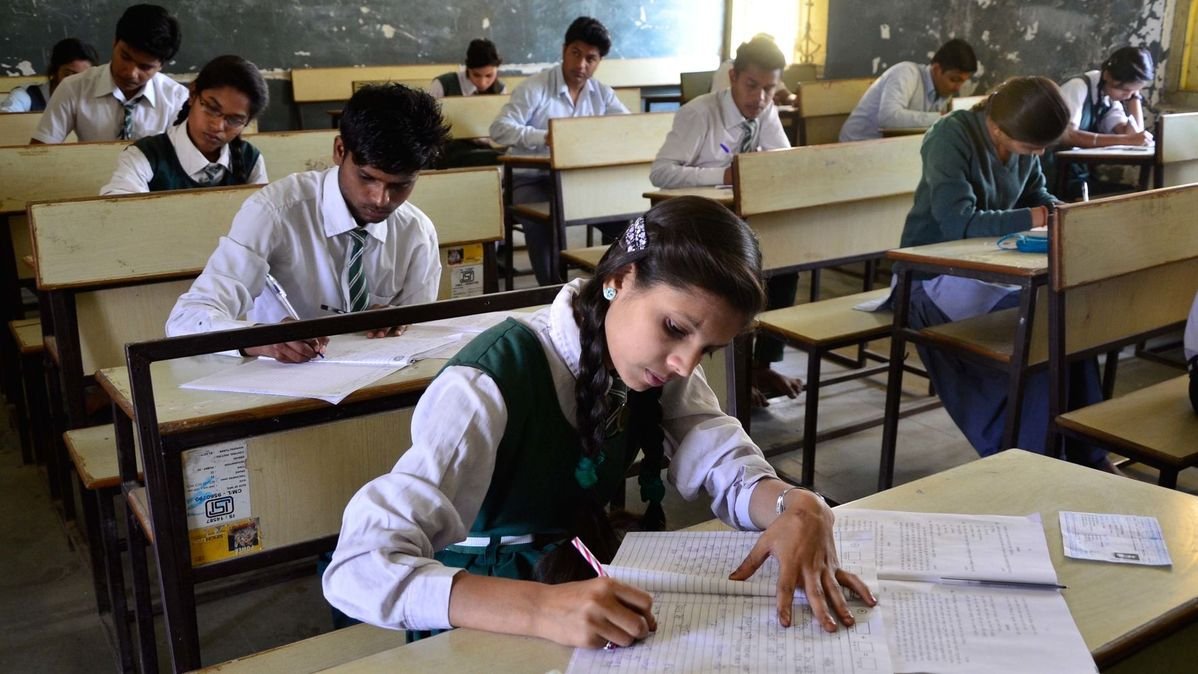





Top 50 MCQs for CBSE Class 11 Chemistry prepare for their Chemistry Half-Yearly Exam 2026. The questions cover key chapters from the syllabus, such as Basic Concepts of Chemistry, Structure of Atom, Chemical Bonding, and States of Matter. Practicing these MCQs will help students quickly revise important topics, test their conceptual understanding, and improve their problem-solving speed.
The Class 11 Chemistry Half-Yearly Exam is a crucial assessment that tests a student’s fundamental understanding of core concepts. Multiple-choice questions are an excellent tool for preparation because they require a strong grasp of the basics and the ability to apply concepts quickly. This set of 50 MCQs is a comprehensive practice resource that touches upon all the important themes from the first few chapters of the Chemistry syllabus.
By attempting these questions, students can get a clear idea of their strengths and weaknesses. The quiz format helps in self-evaluation and provides a quick way to review the entire syllabus. It is highly recommended that students attempt these questions under timed conditions to simulate the pressure of an actual exam. After completing the test, they can use the provided answer key to check their performance and focus on the areas that need more attention.
Top 50 MCQs for CBSE Class 11 Chemistry
Check the unit-wise weightage for CBSE Class 11 Chemsitry syllabus here:
| S. No | UNIT | Marks |
| 1 | Some Basic Concepts of Chemistry | 7 |
| 2 | Structure of an Atom | 9 |
| 3 | Classification of Elements and Periodicity in Properties | 6 |
| 4 | Chemical Bonding and Molecular Structure | 7 |
| 5 | Chemical Thermodynamics | 9 |
| 6 | Equilibrium | 7 |
| 7 | Redox Reactions | 4 |
| 8 | Organic Chemistry: Some Basic Principles and Techniques | 11 |
| 9 | Hydrocarbons | 10 |
| TOTAL | 70 |
Top 50 MCQs for CBSE Class 11 Chemistry Half Yearly Exam 2026
- What is the number of moles of CO₂ present in 44g of CO₂?
(a) 1 mole
(b) 2 moles
(c) 0.5 moles
(d) 44 moles
- The number of atoms in 0.1 mol of a triatomic gas is:

- The empirical formula of a compound is CH₂O. If its molar mass is 180 g/mol, what is its molecular formula?
(a) C₆H₁₂O₆
(b) C₃H₆O₃
(c) C₂H₄O₂
(d) C₆H₁₂O₂
- Which of the following has the highest number of atoms?
(a) 1 g of C
(b) 1 g of O₂
(c) 1 g of NH₃
(d) 1 g of H₂
- The mass of one mole of a substance in grams is called its:
(a) Atomic mass
(b) Molecular mass
(c) Molar mass
(d) Gram formula mass
- Who proposed the planetary model of the atom?
(a) J.J. Thomson
(b) Ernest Rutherford
(c) Niels Bohr
(d) James Chadwick
- The number of protons in an atom with atomic number 17 and mass number 35 is:
(a) 17
(b) 18
(c) 35
(d) 52
- The azimuthal quantum number (l) describes the:
(a) Size of the orbital
(b) Shape of the orbital
(c) Orientation of the orbital
(d) Spin of the electron
- What is the maximum number of electrons that can be accommodated in the M shell?
(a) 8
(b) 18
(c) 32
(d) 50
- The concept of dual nature of matter was proposed by:
(a) Einstein
(b) de Broglie
(c) Heisenberg
(d) Schrödinger
- The uncertainty principle states that it is impossible to simultaneously determine with accuracy:
(a) Position and momentum
(b) Energy and mass
(c) Velocity and acceleration
(d) Spin and charge
- Which of the following elements has the largest atomic radius?
(a) Li
(b) Na
(c) K
(d) Rb
- The element with the highest electronegativity is:
(a) Fluorine
(b) Chlorine
(c) Oxygen
(d) Nitrogen
- Which of the following is an isoelectronic species with Neon (Ne)?
(a) Mg²⁺
(b) Al³⁺
(c) F⁻
(d) All of the above
- The trend of ionization enthalpy generally:
(a) Increases down a group and across a period
(b) Decreases down a group and across a period
(c) Increases across a period and decreases down a group
(d) Decreases across a period and increases down a group
- What is the type of hybridization of the carbon atom in CH₄?
(a) sp
(b) sp²
(c) sp³
(d) dsp²
- The geometry of a molecule with sp³ hybridization is:
(a) Linear
(b) Trigonal planar
(c) Tetrahedral
(d) Trigonal bipyramidal
- Which of the following molecules has a dipole moment?
(a) CO₂
(b) CH₄
(c) H₂O
(d) CCl₄
- The bond order of the N₂ molecule is:
(a) 1
(b) 2
(c) 3
(d) 4
- The VSEPR theory is used to predict the:
(a) Hybridization of the central atom
(b) Geometry of the molecule
(c) Polarity of the molecule
(d) Bond enthalpy of the molecule
- The root mean square (rms) velocity of a gas is directly proportional to the square root of its:
(a) Pressure
(b) Temperature
(c) Volume
(d) Density
- A gas obeys the ideal gas law at:
(a) Low pressure and high temperature
(b) High pressure and low temperature
(c) High pressure and high temperature
(d) Low pressure and low temperature
- Which of the following intermolecular forces is present in H₂O?
(a) London dispersion forces
(b) Dipole-dipole forces
(c) Hydrogen bonding
(d) All of the above
- The term “sublimation” refers to the conversion of a substance from:
(a) Solid to liquid
(b) Liquid to gas
(c) Solid to gas
(d) Gas to liquid
- The boiling point of a liquid is the temperature at which its vapor pressure becomes equal to the:
(a) Standard pressure
(b) Atmospheric pressure
(c) Critical pressure
(d) Saturated vapor pressure
- Hess’s Law of constant heat summation is an application of:
(a) The First Law of Thermodynamics
(b) The Second Law of Thermodynamics
(c) The Third Law of Thermodynamics
(d) Newton’s Law
- The molar heat capacity of an ideal gas at constant volume is:
(a) Cp
(b) Cv
(c) Cp−Cv
(d) Cp+Cv
- For a reversible process, the change in entropy of the universe is:
(a) Positive
(b) Negative
(c) Zero
(d) Always increasing
- The standard enthalpy of formation of an element in its most stable state is:
(a) Positive
(b) Negative
(c) Zero
(d) Indeterminate
- The Gibbs free energy change (ΔG) for a spontaneous process at constant temperature and pressure is:
(a) Positive
(b) Negative
(c) Zero
(d) Constant
- An aqueous solution of NaCl is:
(a) Acidic
(b) Basic
(c) Neutral
(d) Amphoteric
- The pH of a neutral solution at 25°C is:
(a) 0
(b) 7
(c) 14
(d) >7
- Which of the following is a Lewis acid?
(a) NH₃
(b) H₂O
(c) BF₃
(d) CH₄
- The common ion effect is a phenomenon that occurs when:
(a) A strong acid is added to a weak acid
(b) A strong base is added to a weak base
(c) A common ion is added to a solution of a sparingly soluble salt
(d) A strong base is added to a weak acid
- The Henderson-Hasselbalch equation is used to calculate the pH of a:
(a) Strong acid
(b) Strong base
(c) Buffer solution
(d) Salt solution
- The total number of orbitals in a shell with principal quantum number ‘n’ is given by:
(a) n
(b) n²
(c) 2n²
(d) n+1
- The magnetic quantum number (mₗ) determines the:
(a) Size of the orbital
(b) Shape of the orbital
(c) Orientation of the orbital
(d) Spin of the electron
- The number of electrons in an atom with atomic number 11 and mass number 23 is:
(a) 11
(b) 12
(c) 23
(d) 34
- The most electronegative element among the following is:
(a) Carbon
(b) Nitrogen
(c) Oxygen
(d) Fluorine
- The bond angle in the water molecule (H₂O) is approximately:
(a) 180°
(b) 109.5°
(c) 104.5°
(d) 120°
- The hybridization of the central atom in BeCl₂ is:
(a) sp
(b) sp²
(c) sp³
(d) dsp²
- The number of valence electrons in a nitrogen atom is:
(a) 3
(b) 5
(c) 7
(d) 10
- Which of the following is a physical change?
(a) Rusting of iron
(b) Burning of a candle
(c) Melting of ice
(d) Digestion of food
- A mixture of sugar and sand can be separated by:
(a) Evaporation
(b) Sublimation
(c) Filtration
(d) Dissolving in water, followed by filtration and evaporation
- The law of definite proportions states that:
(a) Elements combine in a fixed ratio by mass to form a compound
(b) Mass is conserved in a chemical reaction
(c) A given volume of gas contains the same number of molecules at the same temperature and pressure
(d) Chemical reactions always occur in whole-number ratios
- What is the number of moles of Na in 46 g of Na?
(a) 1 mole
(b) 2 moles
(c) 0.5 moles
(d) 46 moles
- The total number of orbitals in a shell with principal quantum number ‘n’ is given by:
(a) n
(b) n²
(c) 2n²
(d) n+1
- The mass of 1 molecule of H₂SO₄ is approximately:
(a) 98 g
(b) 98 amu
(c) 98 kg
(d) 98 moles
- A buffer solution is a solution that resists a change in:
(a) Volume
(b) Temperature
(c) pH
(d) Concentration
- The oxidation state of sulfur in H₂SO₄ is:
(a) +2
(b) +4
(c) +6
(d) -2
MCQ Answer Key
Question No.
Answer
Question No.
Answer
1 (a) 26 (a) 2 (a) 27 (b) 3 (a) 28 (c) 4 (d) 29 (c) 5 (c) 30 (b) 6 (b) 31 (c) 7 (a) 32 (b) 8 (b) 33 (c) 9 (b) 34 (c) 10 (b) 35 (c) 11 (a) 36 (b) 12 (d) 37 (c) 13 (a) 38 (a) 14 (d) 39 (d) 15 (c) 40 (c) 16 (c) 41 (a) 17 (c) 42 (b) 18 (c) 43 (c) 19 (c) 44 (d) 20 (b) 45 (a) 21 (b) 46 (b) 22 (a) 47 (b) 23 (d) 48 (b) 24 (c) 49 (c) 25 (b) 50 (c) This collection of 50 multiple-choice questions serves as a vital tool for preparing for the CBSE Class 11 Chemistry Half Yearly Exam 2026. By practicing these questions, students can not only assess their knowledge but also identify and work on their weaknesses. Ensure you understand each question thoroughly, revise the concepts, and practice time management to perform well in the examination. Good luck!