

Getting a good score in NEET UG is only half the journey toward becoming a doctor. The next and equally important step is NEET UG Counseling, where students compete for seats in MBBS, BDS, AYUSH, and other medical courses across India. Every year, thousands of students miss opportunities simply because they are unaware of the counseling process, deadlines, or seat allotment rules.
If you have qualified for NEET UG 2026, understanding the counseling process is essential. This detailed guide explains everything you need to know about NEET UG Counseling, from registration to final admission.
What is NEET UG Counseling?
NEET UG Counseling is the centralized admission process conducted for allocating seats in medical and dental colleges based on NEET scores and ranks. Through counseling, eligible candidates can secure admission to MBBS, BDS, BAMS, BHMS, BUMS, BSMS, and other healthcare courses.
The counseling process ensures transparency and fair seat allocation according to merit, category, reservation policies, and candidate preferences.

Why is NEET UG Counseling Important?
Without participating in counseling, a qualified candidate cannot obtain admission to medical colleges through NEET scores. Counseling determines:
- College allocation
- Course allocation
- Category-wise admissions
- Seat upgrades
- Admission confirmation
Therefore, understanding each stage of NEET UG Counseling is critical.
Types of NEET UG Counseling
NEET UG Counseling is conducted at two levels:
1. All India Quota (AIQ) Counseling
The Medical Counseling Committee (MCC) conducts counseling for:
- 15% All India Quota seats
- Central universities
- Deemed universities
- AIIMS institutions
- JIPMER campuses
- ESIC colleges
Students from almost all states can participate in AIQ counseling.
2. State Quota Counseling
Each state conducts its own counseling for:
- 85% State Quota seats
- Private medical colleges
- State government medical colleges
Candidates usually need to meet domicile requirements to participate in state counseling.
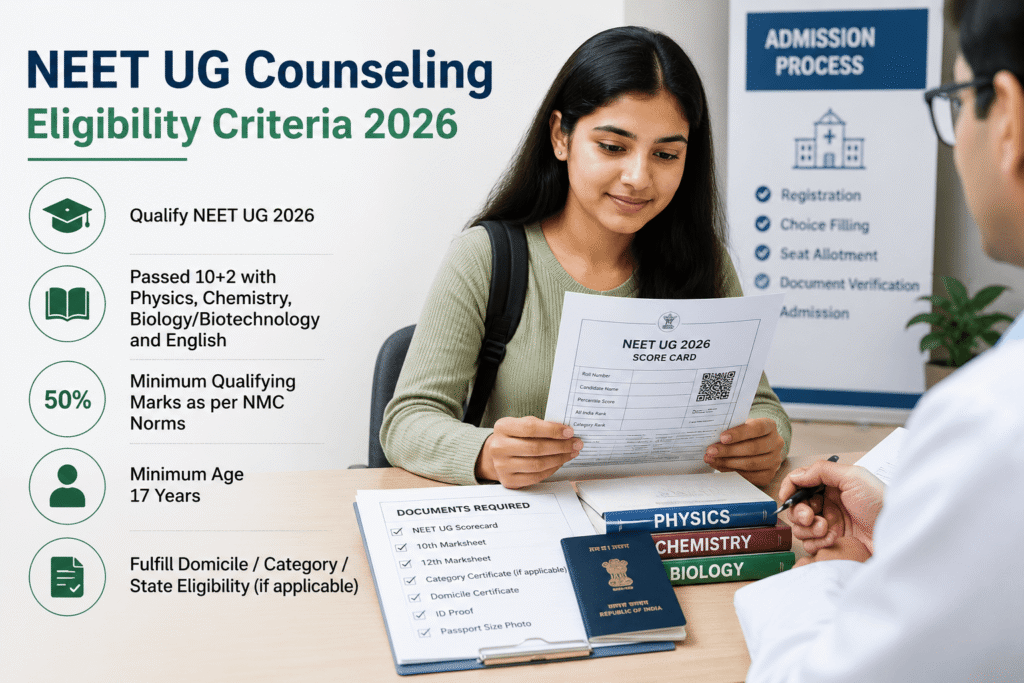
NEET UG Counseling Eligibility Criteria
To participate in NEET UG Counseling, candidates must:
- Qualify NEET UG examination
- Meet category-wise cutoff requirements
- Complete Class 12 with required subjects
- Fulfill age criteria
- Meet state-specific eligibility rules (for state counseling)
Students who fail to meet the minimum qualifying criteria cannot participate in counseling rounds.
NEET UG Counseling Process Step-by-Step
Understanding the entire counseling workflow can help students avoid mistakes.
Step 1: Registration
The first stage involves online registration through the official counseling portal.
Candidates need to:
- Create an account
- Enter personal details
- Verify credentials
- Pay counseling fees
After successful registration, candidates become eligible for further counseling stages.
Step 2: Choice Filling
Choice filling is one of the most important parts of NEET UG Counseling.
Students can select:
- Preferred colleges
- Preferred courses
- State or All India institutions
Tips for Effective Choice Filling
- Fill maximum possible choices.
- Prioritize dream colleges first.
- Include safe options.
- Research previous years’ cutoffs.
- Lock choices before the deadline.
A well-planned choice list significantly increases admission chances.
Step 3: Choice Locking
Once candidates finalize preferences, they must lock their choices.
Failure to lock choices may lead to:
- Auto-locking by the system
- Preference mismatches
- Missed opportunities
Always verify your selections before locking.
Step 4: Seat Allotment
After choice filling, authorities conduct seat allotment based on:
- NEET rank
- Category
- Reservation rules
- Seat availability
- Candidate preferences
Seat allotment results are released online.
Step 5: Reporting to the College
Candidates who receive seats must report to the allotted institution within the specified period.
During reporting:
- Documents are verified
- Fees are paid
- Admission is confirmed
Failure to report may result in cancellation of the allotted seat.
NEET UG Counseling Rounds
The counseling process generally consists of multiple rounds.
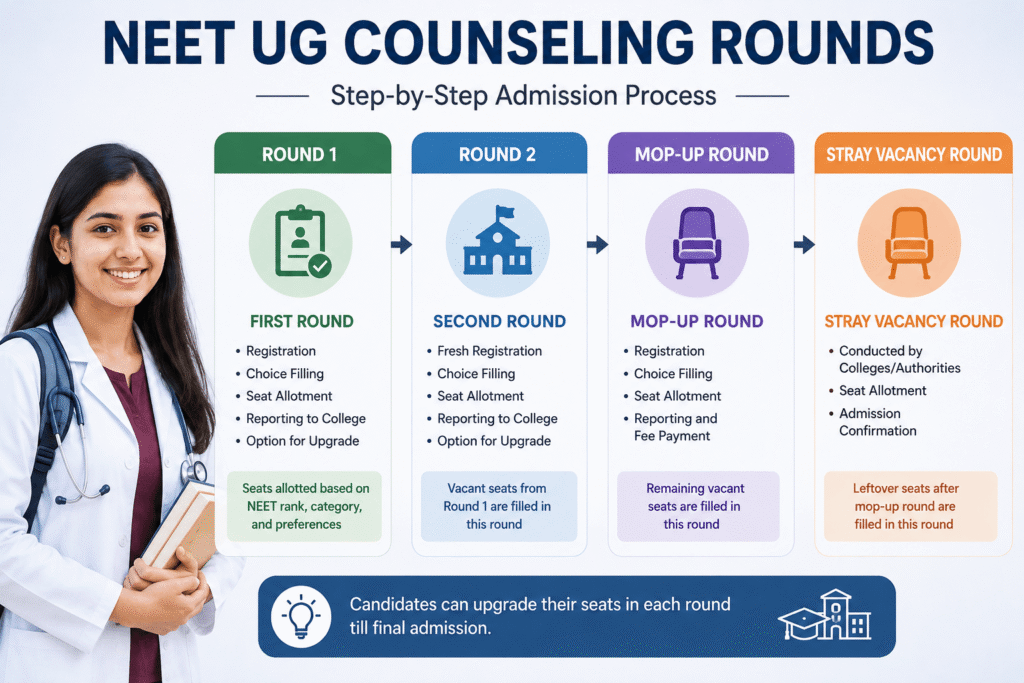
Round 1
This is the first seat allotment round where most seats are allocated.
Students can:
- Accept the allotted seat
- Upgrade in the next round
- Participate further if not satisfied
Round 2
Vacant seats from Round 1 are offered again.
Candidates can:
- Upgrade colleges
- Obtain better branches
- Secure admission if previously unallotted
Mop-Up Round
After the first two rounds, remaining seats are filled through the Mop-Up Round.
This round is especially important for:
- Private medical colleges
- Deemed universities
- Vacant government seats
Stray Vacancy Round
The final stage of NEET UG Counseling fills leftover seats.
Seats are allotted based on merit among eligible candidates.
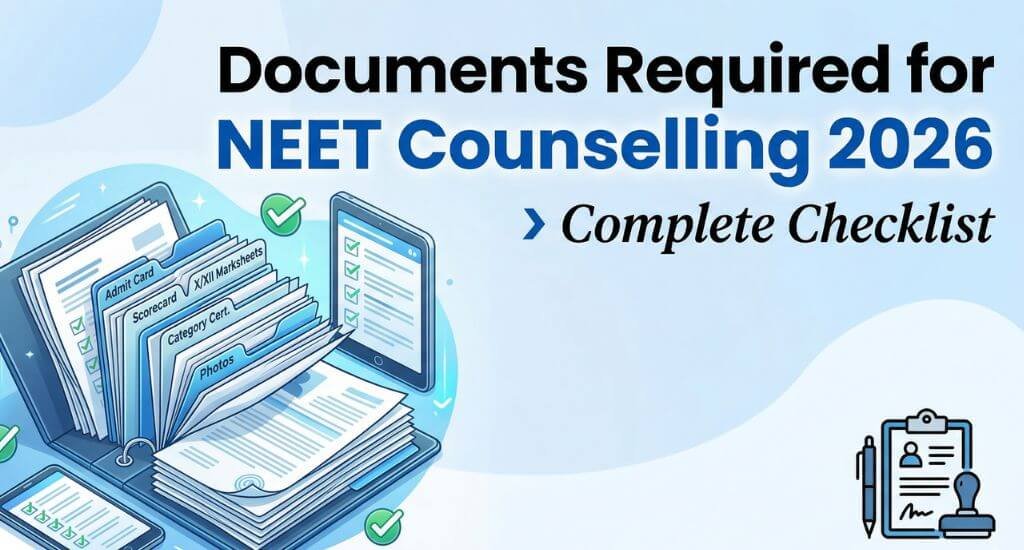
Documents Required for NEET UG Counseling
Students should prepare all required documents in advance.
Essential Documents
- NEET UG Scorecard
- NEET Admit Card
- Class 10 Marksheet
- Class 12 Marksheet
- Transfer Certificate
- Migration Certificate
- Identity Proof
- Passport-size photographs
- Category Certificate (if applicable)
- Domicile Certificate
- PwD Certificate (if applicable)
Document Verification Tips
Keep Originals Ready
Original documents are mandatory during admission.
Maintain Multiple Copies
Carry several photocopies of all documents.
Check Validity
Ensure certificates are valid and updated.
Reservation Policy in NEET UG Counseling
Reservation plays a major role in medical admissions.
Categories Covered
- Scheduled Caste (SC)
- Scheduled Tribe (ST)
- Other Backward Classes (OBC)
- Economically Weaker Section (EWS)
- Persons with Disabilities (PwD)
Reservation benefits vary according to government regulations and counseling authorities.
How Seat Allotment Works
Many students wonder how seats are actually assigned.
Factors Affecting Seat Allotment
NEET Rank
A better rank increases admission chances.
Candidate Preferences
Choice order significantly impacts allocation.
Seat Availability
Limited seats increase competition.
Reservation Rules
Category-based reservations influence seat distribution.
Previous Round Admissions
Vacant seats from earlier rounds affect subsequent allotments.
Common Mistakes Students Make During NEET UG Counseling
Avoiding these mistakes can improve admission outcomes.
1. Filling Too Few Choices
Many students only select top colleges and miss admission opportunities.
2. Missing Deadlines
Late registration can result in complete exclusion from counseling.
3. Ignoring State Counseling
Students often focus only on AIQ counseling and overlook state quota seats.
4. Incorrect Documentation
Incomplete documents can lead to admission cancellation.
5. Not Researching Previous Cutoffs
Understanding cutoff trends helps create realistic preferences.
Strategies to Secure a Good Medical College
A smart counseling strategy can make a significant difference.
Analyze Previous Year Trends
Review:
- Closing ranks
- Opening ranks
- Category-wise cutoffs
- Seat matrices
Use a Balanced Preference List
Include:
- Dream colleges
- Target colleges
- Safe colleges
Participate in All Rounds
Many students receive better colleges in later rounds.
Stay Updated
Regularly check official counseling notifications and announcements.
Government Medical Colleges vs Private Medical Colleges
Students often face confusion while selecting colleges.
Government Medical Colleges
Advantages
- Lower fees
- Better patient exposure
- High academic reputation
Challenges
- Extremely competitive admissions
- Limited seats
Private Medical Colleges
Advantages
- More seat availability
- Wider admission opportunities
Challenges
- Higher tuition fees
- Variable infrastructure quality
Students should evaluate both options carefully.
NEET UG Counseling for AIIMS and JIPMER
Admissions to AIIMS and JIPMER are now conducted through NEET UG Counseling.
Benefits of AIIMS Institutions
- Excellent faculty
- Advanced infrastructure
- Strong clinical exposure
- National reputation
Because of high demand, these institutions typically require top NEET ranks.
Frequently Asked Questions (FAQs)
Is qualifying NEET enough for admission?
No. Candidates must also participate in NEET UG Counseling.
Can I participate in both AIQ and state counseling?
Yes. Eligible candidates can usually participate in both.
What happens if I do not report after seat allotment?
Your allotted seat may be cancelled according to counseling rules.
Can I upgrade my seat?
Yes. Seat upgradation options are available during counseling rounds.
Is counseling mandatory?
Yes. Admission cannot be secured without participating in the counseling process.
Future of NEET UG Counseling
The counseling process continues to become more transparent and technology-driven. Online registration, digital verification, and centralized seat allocation have simplified admissions for lakhs of students across India.
With increasing competition every year, candidates must stay informed about official announcements, seat matrices, reservation updates, and counseling schedules.
Conclusion
NEET UG Counseling is the most crucial step after qualifying the NEET examination. A strong score alone does not guarantee admission; strategic choice filling, timely registration, proper documentation, and active participation in all counseling rounds are equally important.
Whether you aim for a government medical college, a private institution, AIIMS, or a state quota seat, understanding the counseling process can significantly improve your chances of success.