





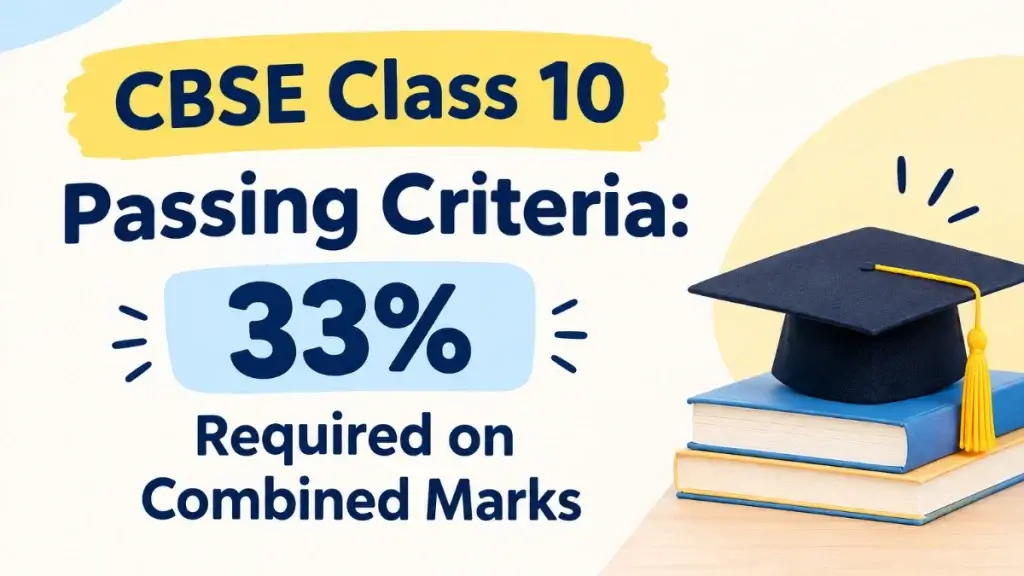
For the 2026–27 academic session, CBSE has clarified that the minimum passing benchmark for Class 10 remains 33%. This means that students must secure at least the prescribed pass level in the applicable assessment, as determined under the Board’s examination scheme. The benchmark has not been replaced by a higher percentage, nor has it been reduced through any new general announcement.
The 33% requirement should be understood alongside the complete assessment structure for each subject. Depending on the subject and the instructions issued by CBSE, the final result may involve written examination marks, internal assessment, practical work, project components, or other prescribed elements. Meeting the overall pass requirement therefore requires students to participate in every applicable component and follow the subject-wise conditions. A student should not assume that performing well in only one part will automatically satisfy all requirements.
It is also important to distinguish the passing percentage from other examination-related developments. CBSE may introduce or revise question-paper formats, increase the proportion of competency-based questions, adjust internal assessment arrangements, or update administrative procedures. Such changes can affect preparation, evaluation, or the conduct of examinations, but they do not automatically alter the minimum passing benchmark. A change in the style of questions, for example, should not be interpreted as a change in the percentage required to pass.
Students and parents should consult official CBSE circulars, the current curriculum and examination documents, and instructions issued by their school. These sources provide the applicable details for subjects, assessment components, attendance, submission requirements, and result conditions. Social-media posts, forwarded messages, coaching materials, and unofficial interpretations may combine separate updates or present incomplete information. Checking the original notification before making academic decisions helps families understand the 2026–27 rules accurately and prepare according to the requirements that actually apply.
The 33% benchmark is best understood within the complete assessment structure of each Class 10 subject. A subject may include marks from the written board examination, internal assessment, practical work, project work, or other school-based activities, depending on the scheme prescribed by CBSE. Therefore, the published total is not always based only on the marks obtained in the final question paper. Students should first identify how many marks are assigned to each component and how those marks contribute to the subject result.
For example, a written examination may carry one portion of the total marks, while internal assessment accounts for the remaining portion. In a subject involving practical or project-based work, the distribution may be different. Securing at least 33% in the written paper does not automatically explain the final outcome in every situation, just as a strong internal-assessment score does not necessarily remove the need to meet any minimum prescribed for the examination component. The relevant CBSE regulations and the current subject-wise scheme determine whether separate component-wise minimum marks apply.
This distinction is important because obtaining 33% in an individual component is not always the same as achieving the required overall subject result. A student could perform adequately in one part but still need additional marks in another part to meet the aggregate requirement. Conversely, where the rules permit marks from different components to be combined, the overall subject total may be calculated according to that specific provision. Students should avoid applying one uniform calculation to every subject or relying solely on informal explanations of the pass criteria.
Language subjects, academic subjects such as mathematics and science, and skill- or practical-oriented subjects may all have different assessment distributions. The broad passing benchmark remains 33%, but its application can vary with the approved assessment pattern. Students should consequently consult the latest CBSE curriculum, examination circulars, and subject-specific instructions, while also confirming how their school records internal or practical marks. This approach provides a more accurate understanding of the Class 10 result and helps students plan preparation across every assessed component.
Consider a hypothetical student who receives 24 marks in a 80-mark theory paper and 12 marks in a 20-mark internal assessment. The combined total is 36 out of 100, which may appear to cross the 33% benchmark. However, this arithmetic alone does not establish that the student has passed. If the applicable CBSE requirements include a separate minimum in the theory examination, the student may still be required to improve the theory score, even though the internal marks raise the overall total.
A second example shows the opposite possibility. Suppose another student earns 28 marks in theory and 7 marks internally, producing 35 marks altogether. The total exceeds 33%, but the result must still be interpreted under the rules applicable to that subject and examination year. These figures are only illustrations, not official substitutes for CBSE regulations. The relevant pass condition may depend on component-wise requirements, the subject structure, and whether practical or project work is separately assessed.
The 33% figure should therefore be understood as a minimum benchmark rather than a target that guarantees a strong result. A student who obtains 33% in one subject has not automatically passed every other subject. Each subject result generally needs to be considered independently. Similarly, a high overall aggregate cannot always compensate for a failure in a particular subject or in a separately required component. Adding theory and internal-assessment marks is useful for understanding a score, but it cannot replace checking the applicable minimum requirements.
Grades, pass or fail status, supplementary or compartment opportunities, and classifications such as an overall division may involve additional conditions. Those conditions can also vary according to the examination scheme and the rules in force for the relevant session. Students and parents should read the latest CBSE examination bye-laws, official circulars, and result instructions rather than relying on informal calculations. For a case-specific interpretation—especially where practical marks, internal assessment, or a compartment result is involved—the student should consult the school or the CBSE directly.
The unchanged 33% benchmark gives students a clear minimum target, but preparing only to reach that threshold is risky. Aim for a comfortable safety margin in every subject so that an unexpectedly difficult paper, a missed question, or a small marking variation does not threaten the final result. Begin with foundational concepts, definitions, formulas, and standard methods before moving to advanced applications. A strong base also makes revision faster and improves confidence across different question formats.
Use previous-style questions, school test papers, and the sample papers released or recommended by CBSE to understand the expected level and structure. Practise writing complete answers within the allotted time, then review mistakes rather than merely checking scores. Read the current marking scheme carefully, noting how marks are divided among steps, reasoning, diagrams, language, and internal components. Teachers can clarify which points are essential for earning partial or full credit.
Internal assessment should receive the same attention as the written examination. Complete assignments, projects, practical records, subject activities, and other school work by their deadlines. Attend applicable practical sessions and activities, retain project files and supporting records, and confirm with the school that every submission has been received and entered correctly. Delayed or missing work can affect the overall subject result even when examination preparation is adequate.
Families can use this checklist: verify the assessment pattern for each subject; track marks from school tests; identify weak chapters early; ask teachers how theory, practical, project, and internal marks are calculated; and monitor whether required work has been recorded. Students should revisit the plan after each test and allocate additional practice to low-scoring areas. Finally, follow official CBSE communications and school notices for any further instructions. The stable benchmark reduces uncertainty about the minimum threshold, but successful completion still requires meeting all applicable subject and assessment requirements.