
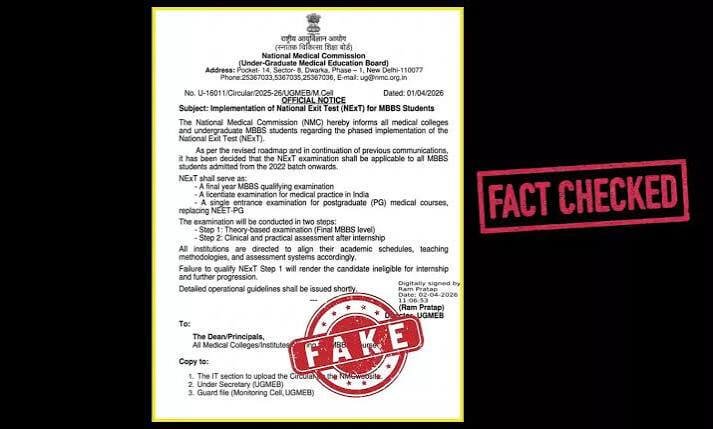
NEET A public notice circulating online claims that the qualifying percentile for NEET 2026 counselling has been reduced. The message is generally presented as an official announcement affecting candidates who are preparing to participate in the counselling process. Although the wording and presentation may differ across versions, the central allegation remains the same: students who previously might not have met the stated threshold could now become eligible to register, compete for seats, or participate in subsequent admission rounds.
The claim has attracted considerable attention because counselling cutoffs directly influence medical admission opportunities. A change in the qualifying percentile can affect the number of eligible candidates, the pool competing for government and private seats, and the choices available during counselling. Medical aspirants and their parents therefore have a strong reason to monitor any reported revision. Coaching centres, education forums, and student groups have also amplified the notice, often discussing its possible effect on eligibility, registration strategies, and admission prospects before its authenticity has been established.
Versions of the circulating notice may contain features designed to make the announcement appear credible. These can include government-style language, an official-looking layout, institutional logos, reference numbers, publication dates, signatures, seals, or mentions of national and state counselling authorities. Such details can create an impression of legitimacy, particularly when the notice is shared as a screenshot or forwarded image without a link to its original source. However, visual presentation alone cannot verify an administrative decision. A screenshot, message, or social-media post should not be treated as official confirmation unless the same information appears through the authorised website or a clearly identifiable communication channel of the relevant examination or counselling authority. Candidates should check the original notice, issuing body, publication date, and current counselling guidelines before relying on any claimed reduction in the NEET 2026 counselling cutoff.
The circulated notice claiming that the NEET 2026 counselling cutoff percentile has been reduced should not be treated as an authentic government announcement. At present, the material is fake or unverified unless the alleged change can be confirmed through the competent examination or counselling authority. An image, screenshot, or forwarded message alone cannot establish that eligibility criteria have been officially revised.
The first verification step is to compare the notice with announcements published on the official websites of the National Testing Agency, the National Medical Commission, the Medical Counselling Committee, or the relevant state counselling authority. A genuine change would normally appear as a formal notification, public notice, information bulletin update, or counselling schedule issued through one of these recognized channels. If no corresponding announcement is available, the claim should be regarded with caution.
Readers should also examine the document itself. An authentic circular generally includes a verifiable notification or reference number, the name of the issuing department, a clear date, official contact details, and the name and designation of an authorized signatory. Missing information, unexplained abbreviations, inconsistent dates, or contact details unrelated to a government domain are significant warning signs.
Language and presentation provide further clues. Genuine government communications usually follow established terminology, formatting, letterhead, branding, and administrative conventions. Spelling errors, unusual promises, poor alignment, altered logos, informal wording, or references to a “confirmed” decision without procedural details may indicate that the notice has been edited or fabricated.
Independent confirmation is equally important. Established news organizations and verified official social-media accounts may report a major change, particularly when it affects thousands of medical aspirants. However, media coverage should also lead back to a primary government source rather than repeat an unverified image. A legitimate revision to the NEET 2026 counselling cutoff would be communicated formally by the competent authority, not solely through a viral post or forwarded message. Until such confirmation appears, candidates should follow the existing official eligibility information and avoid making counselling decisions based on the circulated notice.
Students should treat the official NEET 2026 information bulletin as the primary source for eligibility requirements, examination rules, and qualifying criteria. After the examination, they should also monitor formally issued notices from the National Testing Agency (NTA), the Medical Counselling Committee (MCC), and the appropriate state counselling authority. The relevant authority depends on the seat and institution involved. MCC generally publishes information for counselling connected with eligible national-level seats and participating institutions, while state authorities issue instructions for seats managed through their respective state processes.
Several terms used in admissions reporting are often confused. The NEET qualifying percentile is the minimum relative performance standard required to qualify for counselling eligibility. The score needed to reach that percentile can vary from one year to another because it depends on the examination results and the applicable rules. A counselling or admission cutoff is different: it may refer to the score or rank at which a particular course, college, category, or seat was available in a previous round or year. That later cutoff cannot automatically be treated as the qualifying requirement for NEET 2026.
Authorities may publish separate updates covering qualifying criteria, counselling schedules, category-wise eligibility, document requirements, seat allocation, or admission procedures. A notice addressing one of these subjects does not necessarily change the others. For example, a revised counselling timetable should not be interpreted as a change in the qualifying percentile, and a previous college-specific closing rank cannot establish a new national eligibility rule.
Accordingly, applicants should wait for a formally published notification before accepting any claim that the percentile requirement has been reduced or otherwise revised. Until an authorized update appears on the NTA, MCC, or relevant state authority website, students should continue preparing and follow the rules currently stated in the official bulletin and valid notices. Social media posts, forwarded messages, and unattributed public notices should not replace these authoritative documents when making examination or counselling decisions.
Students and families can reduce the risk of being misled by treating every change to NEET 2026 counselling as unverified until it appears through an authorized channel. Begin with the official NTA NEET portal, then check the Medical Counselling Committee (MCC) counselling portal and the relevant state counselling website. Official authority accounts may provide alerts, but they should direct users to an official document.
Do not rely on a screenshot, forwarded message, short video, or cropped image as proof. Open the original post or notice and inspect its web address. Look for spelling errors, domains, copied logos, missing reference numbers, and links that redirect to unrelated pages. Check the publication date, time, and whether the notice has been superseded by a newer update. A genuine announcement should be traceable to the authority’s website and normally carry identifiable details such as a notification number, signature, or contact information.
NEET Compare the claim with the latest NEET information bulletin and counselling instructions. Pay particular attention to eligibility rules, rank requirements, schedule, and fee provisions; a dramatic cutoff reduction should not be accepted without a formal revision. If uncertainty remains, ask school officials or coaching staff to review the underlying official document, rather than asking them to validate a screenshot. Their guidance is useful only after the source has been authenticated.
Until confirmation, do not pay a fee, alter application choices, share Aadhaar, OTP, passwords, bank details, or other personal information, and do not stop preparing because of an unverified cutoff claim. Save the post, record its URL, and report misleading content through the platform’s reporting tools or to the relevant authority. If correcting others, share a clear message stating that the public notice is fake and include the official source. Only an authorized authority can announce a valid change to NEET 2026 counselling eligibility.