





Introduction
For thousands of medical aspirants across India, clearing NEET is only the first step toward securing a seat in a medical college. The next crucial stage is the NEET Seat Allotment process, which determines whether a candidate gets admission to their preferred medical, dental, or allied health sciences college.
Every year, lakhs of students participate in counselling conducted by the Medical Counselling Committee (MCC) and various state authorities. Understanding how seat allotment works can significantly improve your chances of securing admission to a top institution.
In this comprehensive guide, we will explain everything you need to know about NEET Seat Allotment 2026, including counselling rounds, eligibility criteria, seat matrix, choice filling, allotment results, important factors, and tips for securing your desired seat.
What is NEET Seat Allotment?
NEET Seat Allotment is the process through which eligible candidates are assigned seats in medical colleges based on their:
- NEET rank
- NEET score
- Category
- Reservation status
- Availability of seats
- Choices filled during counselling
The allotment process is conducted after the publication of NEET results and counselling registration.
Candidates who qualify NEET can participate in:
- All India Quota (AIQ) Counselling
- State Quota Counselling
- Deemed University Counselling
- Central University Counselling
- AIIMS and JIPMER Admissions through NEET
The seat allotted to a candidate depends on merit and preference order submitted during counselling.
Why is NEET Seat Allotment Important?
The seat allotment process directly impacts your medical career because it determines:
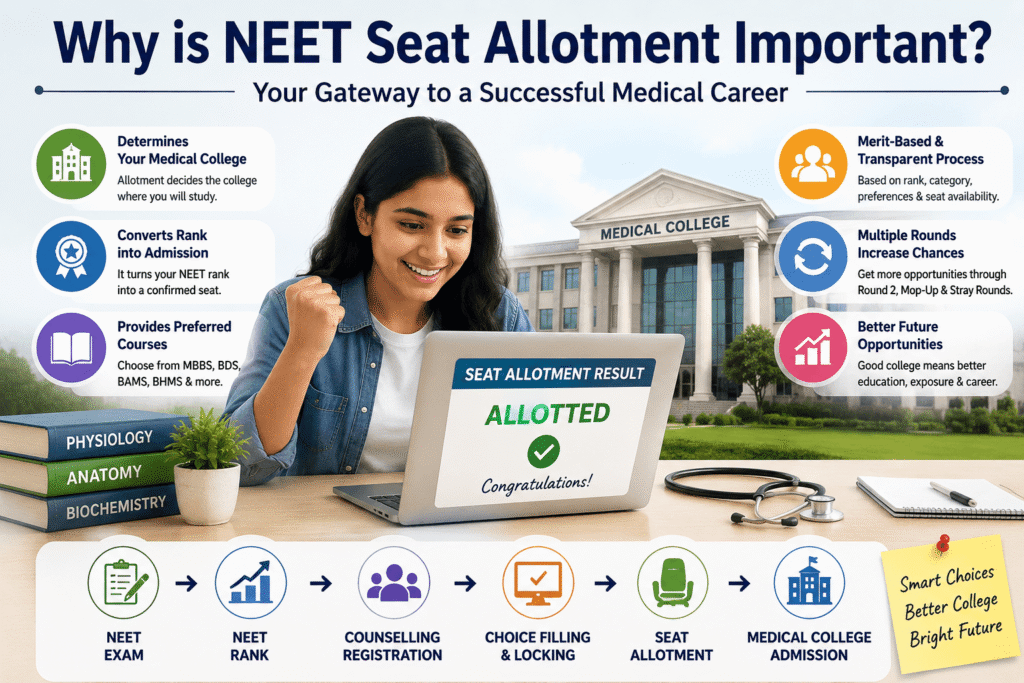
- The college you will attend
- The course you will study
- Tuition fees and expenses
- Future internship opportunities
- Career prospects
Even candidates with excellent NEET scores may lose opportunities if they do not understand the counselling and allotment process properly.
NEET Seat Allotment 2026 Overview
Key Highlights
| Particulars | Details |
|---|---|
| Exam Name | NEET UG 2026 |
| Conducting Body | National Testing Agency (NTA) |
| Counselling Authority | MCC and State Authorities |
| Courses Covered | MBBS, BDS, BAMS, BHMS, BUMS, BSMS |
| Counselling Mode | Online |
| Seat Allotment Basis | Rank, Choices, Category, Seat Availability |
| Allotment Result | Published Online |
Types of NEET Counselling
1. All India Quota (AIQ) Counselling
MCC conducts counselling for:
- 15% AIQ seats
- Central Universities
- AIIMS institutions
- JIPMER campuses
- ESIC colleges
- Deemed Universities
Students from all states can participate in AIQ counselling.
2. State Quota Counselling
State authorities conduct counselling for:
- 85% state quota seats
- Government colleges
- Private colleges within the state
Eligibility requirements vary from state to state.
3. Deemed University Counselling
Candidates seeking admission to deemed universities must register through MCC counselling.
Eligibility for NEET Seat Allotment
Candidates must fulfill certain conditions before participating in counselling.
Basic Eligibility Requirements
- Must qualify NEET UG 2026.
- Must meet the required cutoff score.
- Must have completed Class 12 with Physics, Chemistry, and Biology.
- Must satisfy age criteria prescribed by authorities.
- Must possess valid documents.
Failure to meet eligibility conditions can lead to cancellation of allotment.
NEET Seat Allotment Process Step by Step
Understanding the complete process helps candidates avoid mistakes during counselling.
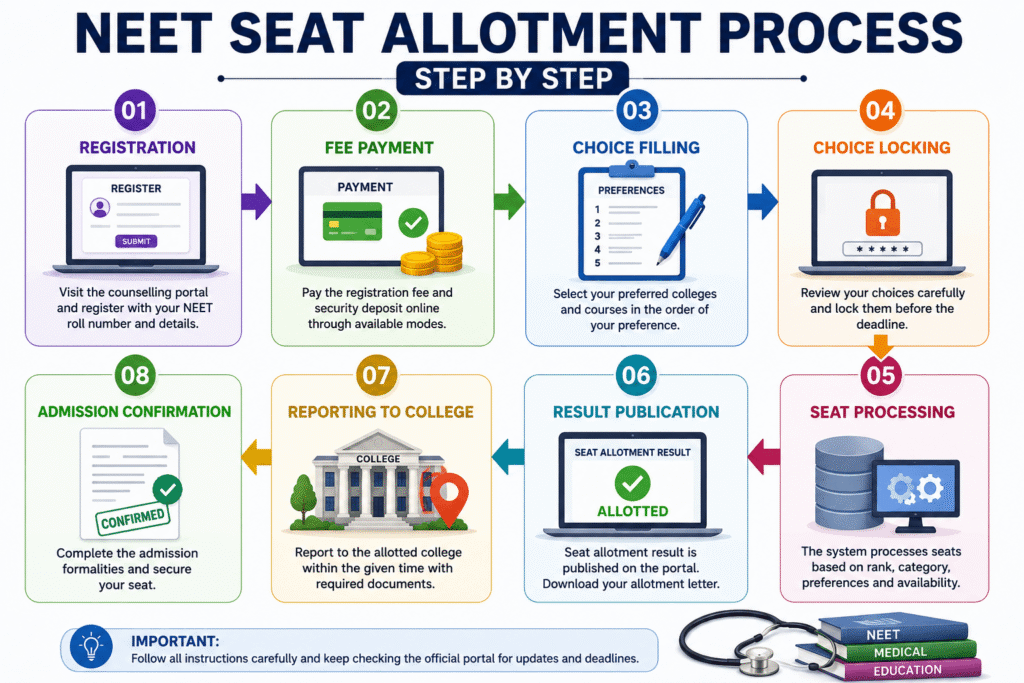
Step 1: Registration
Candidates register on the counselling portal.
Required details include:
- NEET Roll Number
- Application Number
- Personal Information
- Contact Details
Step 2: Fee Payment
After registration, candidates pay:
- Registration fee
- Security deposit
The fee varies according to category and counselling type.
Step 3: Choice Filling
This is one of the most important stages.
Candidates select:
- Colleges
- Courses
- Preference order
The order of choices significantly affects allotment results.
Step 4: Choice Locking
Candidates must verify and lock choices before the deadline.
Unlocked choices may be automatically considered by the system.
Step 5: Seat Processing
The counselling authority processes seats based on:
- Merit rank
- Category
- Preferences
- Seat availability
Step 6: Result Publication
The authority publishes the NEET Seat Allotment Result online.
Candidates can download their allotment letter.
Step 7: Reporting to College
Candidates must report within the specified period.
Failure to report may result in seat cancellation.
NEET Seat Allotment Rounds
The counselling process generally includes multiple rounds.
Round 1
This is the first opportunity for candidates to secure admission.
Features include:
- Fresh registration
- Choice filling
- Initial seat allocation
Round 2
Candidates who:
- Were not allotted seats
- Want better options
- Opt for upgradation
can participate.
Mop-Up Round
The mop-up round fills vacant seats after Round 2.
This round is especially important for:
- Private colleges
- Deemed universities
- Remaining government seats
Stray Vacancy Round
The final stage of admission.
Vacant seats are filled based on eligibility and merit.
Factors Affecting NEET Seat Allotment
Several factors influence the final seat allocation.
NEET Rank
Higher ranks generally receive better college options.
Choice Preferences
Candidates who strategically arrange their preferences often achieve better outcomes.
Seat Availability
The number of seats available directly impacts allotment.
Reservation Policies
Reservation categories such as:
- SC
- ST
- OBC
- EWS
- PwD
affect seat distribution.
Number of Applicants
Increased competition may raise cutoff requirements.
Understanding the NEET Seat Matrix
The seat matrix provides details about available seats.
Information Included
- College name
- Course offered
- Category-wise seats
- Quota-wise seats
- Available vacancies
Candidates should thoroughly analyze the seat matrix before filling choices.
Benefits of Reviewing the Seat Matrix
- Better decision-making
- Realistic expectations
- Strategic preference selection
- Improved admission chances
Documents Required for NEET Seat Allotment
Candidates must keep the following documents ready.
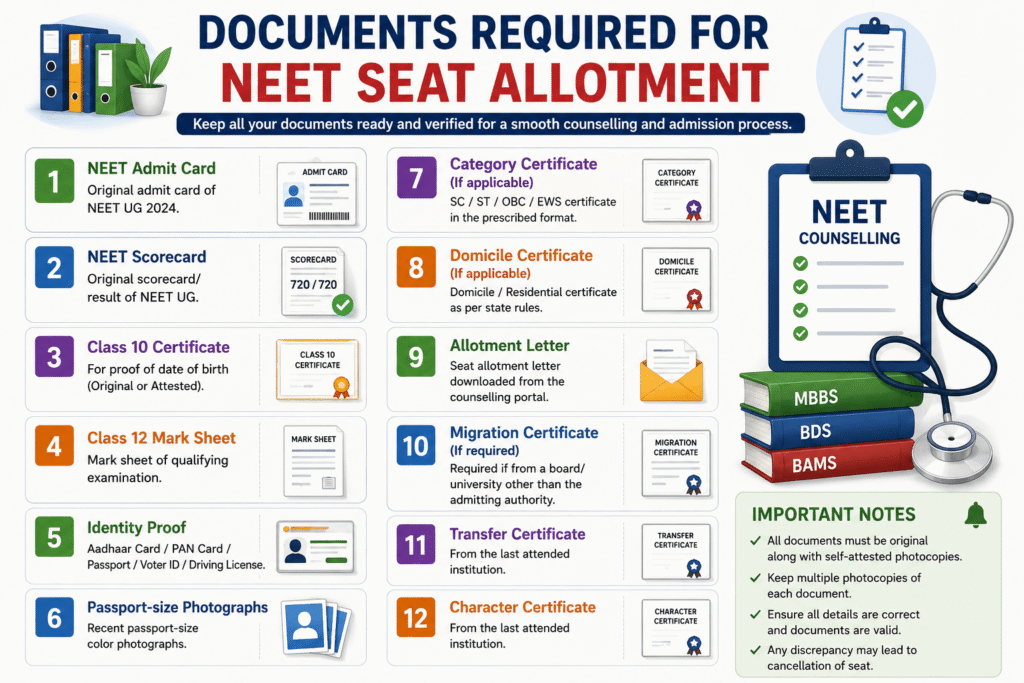
Essential Documents
- NEET Admit Card
- NEET Scorecard
- Class 10 Certificate
- Class 12 Mark Sheet
- Identity Proof
- Passport-size Photographs
- Category Certificate (if applicable)
- Domicile Certificate
- Allotment Letter
- Migration Certificate (if required)
Original documents are generally verified during reporting.
How to Check NEET Seat Allotment Result?
Candidates can follow these steps:
Step-by-Step Process
- Visit the counselling portal.
- Log in using credentials.
- Open the seat allotment section.
- Download the allotment result.
- Print the allotment letter.
Candidates should verify all details carefully.
What Happens After Seat Allotment?
Once a seat is allotted, candidates have several options.
Option 1: Accept the Seat
Candidates can:
- Download allotment letter
- Report to the allotted college
- Complete admission formalities
Option 2: Upgrade the Seat
Candidates satisfied with admission but seeking a better college may choose upgradation.
Option 3: Decline the Seat
Candidates can participate in subsequent counselling rounds if eligible.
Common Reasons for Seat Cancellation
Students should avoid mistakes that may lead to cancellation.
Major Reasons
- Failure to report on time
- Submission of incorrect documents
- False information during registration
- Non-payment of fees
- Missing verification deadlines
Careful attention to deadlines is essential.
Tips to Improve Your Chances During NEET Seat Allotment
Research Colleges Thoroughly
Before counselling, analyze:
- Rankings
- Infrastructure
- Faculty
- Clinical exposure
- Placement records
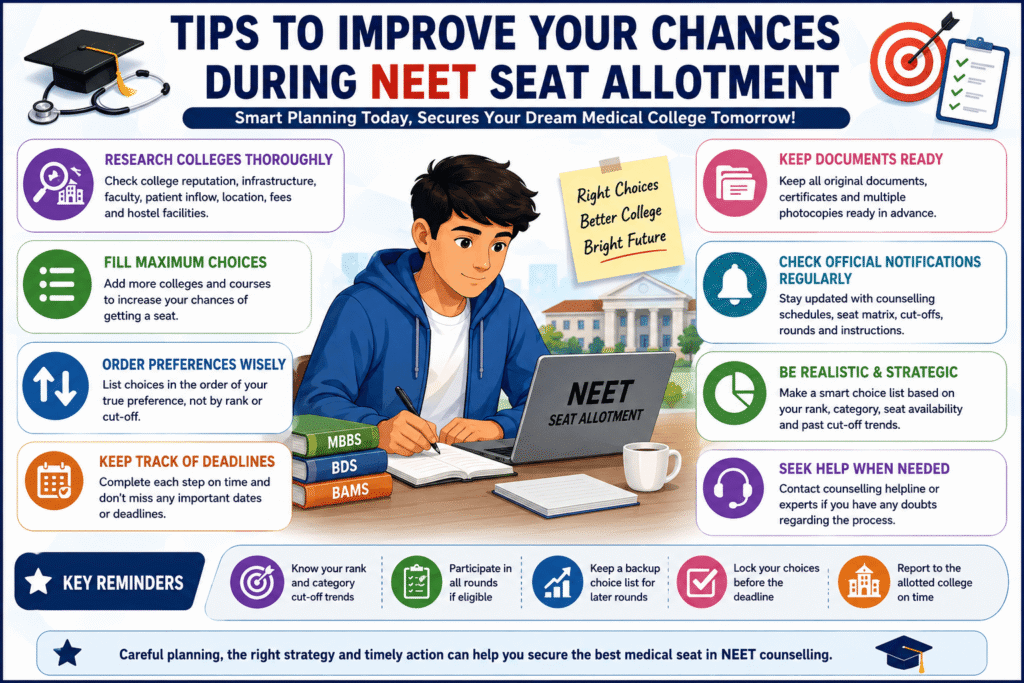
Fill Maximum Choices
Adding more preferences increases allotment possibilities.
Prioritize Preferences Carefully
Arrange colleges according to:
- Academic goals
- Location preferences
- Budget considerations
Monitor Official Notifications
Keep checking counselling updates regularly.
Keep Documents Ready
Prepare all required certificates before counselling begins.
NEET Seat Allotment for Government Medical Colleges
Government colleges remain the most sought-after institutions because of:
- Affordable fees
- Strong clinical exposure
- Better patient inflow
- High academic standards
Due to intense competition, candidates need strong NEET scores to secure admission.
NEET Seat Allotment for Private Medical Colleges
Private colleges provide additional opportunities for admission.
Advantages include:
- Larger seat availability
- More counselling opportunities
- Diverse course options
However, candidates should carefully evaluate fee structures before selecting colleges.
Mistakes to Avoid During NEET Counselling
Many students lose valuable opportunities due to avoidable errors.
Common Mistakes
- Filling random choices
- Ignoring seat matrix data
- Missing deadlines
- Not locking choices
- Uploading incorrect documents
- Failing to monitor counselling notices
Avoiding these mistakes can significantly improve admission outcomes.
Expected Trends for NEET Seat Allotment 2026
The competition for medical seats continues to increase every year.
Expected trends include:
- Higher participation rates
- Increased competition for government colleges
- Expansion of medical seats in some states
- Greater emphasis on strategic choice filling
Candidates should prepare thoroughly and stay updated throughout the counselling process.
Frequently Asked Questions (FAQs)
Is qualifying NEET enough for admission?
No. Candidates must also participate in counselling and complete the seat allotment process.
Can I participate in both AIQ and state counselling?
Yes, eligible candidates can generally participate in both.
What if I do not get a seat in Round 1?
You can participate in subsequent rounds if eligible.
Can I upgrade my allotted seat?
Yes, upgrade options are usually available during later counselling rounds.
Is reporting to the allotted college mandatory?
Yes. Failure to report within the deadline may result in seat cancellation.
Conclusion
The NEET Seat Allotment process is one of the most important stages in securing admission to a medical college. A strong NEET score certainly helps, but understanding counselling rules, filling choices strategically, monitoring deadlines, and preparing documents are equally important.
Whether you are targeting a government medical college, private institution, AIIMS, or a deemed university, careful planning can significantly improve your admission prospects. Stay informed, follow official counselling notifications, and make well-researched choices throughout the process.