






The National Eligibility cum Entrance Test (NEET) is one of the most competitive medical entrance examinations in India. Every year, millions of students appear for this exam with the dream of securing admission to top medical and dental colleges across the country. While hard work and dedication are essential, understanding the NEET Exam Pattern is equally important for achieving a high score.
A clear understanding of the examination structure helps students prepare strategically, manage their time effectively, and avoid surprises on exam day. Whether you are a first-time candidate or a repeater aiming for a better rank, knowing the latest NEET Exam Pattern can significantly improve your preparation.
In this comprehensive guide, we will discuss the NEET Exam Pattern in detail, including the marking scheme, subject-wise question distribution, exam duration, preparation strategies, and frequently asked questions.
What is NEET?
NEET (National Eligibility cum Entrance Test) is the single national-level entrance examination conducted for admission to undergraduate medical courses such as:
- MBBS
- BDS
- BAMS
- BHMS
- BUMS
- BSMS
- Veterinary courses
- Other allied medical programs
The examination is conducted by the National Testing Agency (NTA) and serves as the gateway to medical colleges across India.
Why Understanding the NEET Exam Pattern is Important
Many students focus only on studying the syllabus and often ignore the exam structure. However, understanding the NEET Exam Pattern offers several advantages:
- Helps create an effective study plan
- Improves time management skills
- Reduces examination anxiety
- Enables strategic question-solving
- Increases overall confidence
Knowing exactly what to expect allows candidates to approach the examination with a clear strategy.
NEET Exam Pattern 2026 Overview
The NEET examination follows a standardized format designed to assess a student’s understanding of Physics, Chemistry, and Biology.

Key Highlights
| Particulars | Details |
|---|---|
| Exam Name | NEET UG 2026 |
| Conducting Body | National Testing Agency (NTA) |
| Exam Mode | Offline (Pen and Paper) |
| Question Type | Multiple Choice Questions (MCQs) |
| Total Questions | 180 |
| Total Marks | 720 |
| Duration | 3 Hours |
| Subjects | Physics, Chemistry, Biology |
| Negative Marking | Yes |
| Language Options | Multiple Languages |
The NEET Exam Pattern remains one of the most important aspects students should understand before beginning their preparation journey.
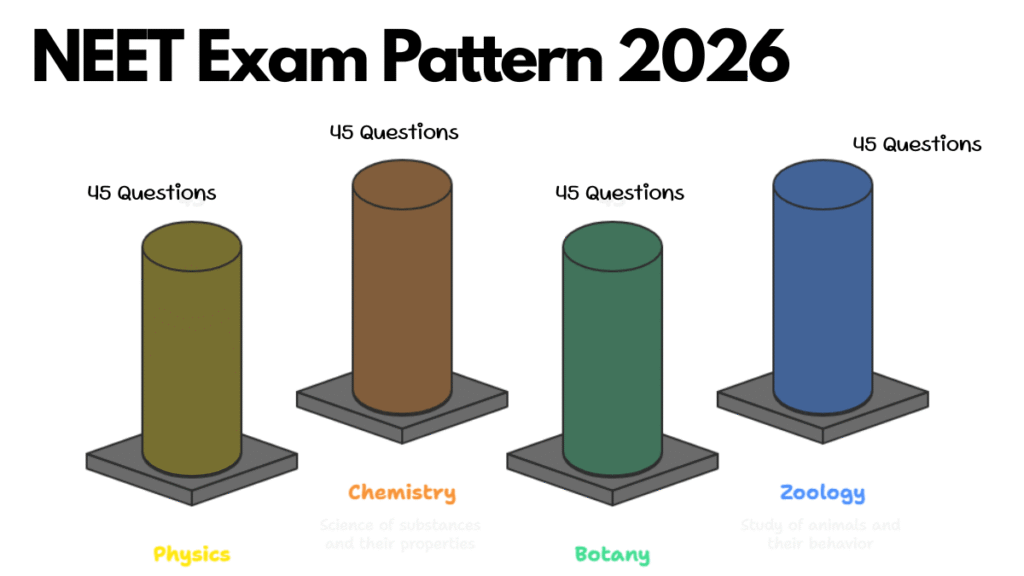
Subject-Wise Distribution of Questions
The NEET question paper is divided into three primary subjects.
Physics
- Total Questions: 45
- Total Marks: 180
Physics often appears challenging for many students because it involves numerical calculations and conceptual understanding.
Important Physics Topics
- Mechanics
- Thermodynamics
- Optics
- Modern Physics
- Current Electricity
- Electrostatics
- Magnetism
Chemistry
- Total Questions: 45
- Total Marks: 180
Chemistry is generally divided into Physical Chemistry, Organic Chemistry, and Inorganic Chemistry.
Important Chemistry Topics
- Chemical Bonding
- Organic Reactions
- Thermodynamics
- Equilibrium
- Coordination Compounds
- p-Block Elements
Biology
Biology carries the highest weightage in NEET.
Botany
- Questions: Approximately 45
- Marks: 180
Zoology
- Questions: Approximately 45
- Marks: 180
Important Biology Topics
- Genetics
- Human Physiology
- Plant Physiology
- Ecology
- Biotechnology
- Reproduction
- Cell Biology
Since Biology accounts for half of the total marks, students should dedicate significant preparation time to this subject.
Detailed Marking Scheme
Understanding the marking scheme is crucial for maximizing scores.
Positive Marking
For every correct answer:
- +4 Marks
Negative Marking
For every incorrect answer:
- -1 Mark
Unattempted Questions
- 0 Marks
Example Calculation
Suppose a student answers:
- Correct Answers: 150
- Incorrect Answers: 20
- Unattempted Questions: 10
Score Calculation:
- Correct: 150 × 4 = 600
- Incorrect: 20 × (-1) = -20
Final Score = 580
This demonstrates why accuracy is just as important as attempting more questions.
NEET Exam Duration
The NEET examination is conducted for:
Total Duration
3 Hours (180 Minutes)
Candidates must answer all 180 questions within this time limit.
Suggested Time Allocation
A practical approach could be:
- Biology: 70–80 Minutes
- Chemistry: 50–55 Minutes
- Physics: 45–50 Minutes
The exact allocation may vary depending on individual strengths.
Language Options Available
The NEET Exam Pattern allows candidates to choose from multiple languages.
Available Languages
- English
- Hindi
- Assamese
- Bengali
- Gujarati
- Kannada
- Malayalam
- Marathi
- Odia
- Punjabi
- Tamil
- Telugu
- Urdu
Students should select the language in which they are most comfortable.
NEET Syllabus and Exam Pattern Relationship
The syllabus and exam pattern work together to define the examination structure.
Physics Weightage
Important chapters often include:
- Current Electricity
- Electromagnetic Induction
- Modern Physics
- Laws of Motion
Chemistry Weightage
High-scoring areas include:
- Organic Chemistry
- Chemical Bonding
- Coordination Chemistry
Biology Weightage
Major focus areas include:
- Genetics
- Human Physiology
- Ecology
- Biotechnology
Understanding chapter-wise weightage can help students prioritize their preparation.
Time Management Strategy for NEET
A strong time-management plan can make a significant difference.
Step 1: Start with Your Strongest Subject
This builds confidence and momentum.
Step 2: Avoid Spending Too Much Time on One Question
If a question seems difficult:
- Mark it
- Move ahead
- Return later
Step 3: Keep Track of Time
Check your progress every 30 minutes.
Step 4: Leave Time for Revision
Reserve at least:
- 10–15 Minutes
for reviewing marked questions.
Common Mistakes Students Make
Many aspirants lose marks because of avoidable mistakes.
1. Ignoring Negative Marking
Random guessing often reduces scores.
2. Poor Time Management
Spending too much time on Physics can affect performance in Biology and Chemistry.
3. Lack of Mock Tests
Mock tests help simulate the actual examination environment.
4. Not Reading Questions Carefully
Many students know the concept but choose the wrong option due to careless reading.
5. Overlooking NCERT
Especially in Biology and Chemistry, NCERT remains the most important resource.
Effective Preparation Tips Based on the NEET Exam Pattern
Focus on NCERT First
The majority of NEET questions are based on NCERT concepts.

Practice Daily MCQs
Solve:
- 80–100 MCQs daily
to improve speed and accuracy.
Attempt Full-Length Mock Tests
Mock tests help you:
- Improve speed
- Analyze mistakes
- Build confidence
Maintain Error Notes
Keep a notebook of frequently repeated mistakes and revise it regularly.
Revise Frequently
Revision strengthens retention and improves recall during the examination.
Best Study Plan for NEET Aspirants
Morning Session
- Biology Theory
- NCERT Revision
Afternoon Session
- Chemistry Concepts
- Practice Questions
Evening Session
- Physics Numerical Problems
Night Revision
- Quick review of formulas
- Important diagrams
- Previous mistakes
Consistency is more effective than studying for long hours occasionally.
NEET Previous Year Trends
Analyzing previous papers provides useful insights.
Observations
- Biology generally carries straightforward questions.
- Chemistry often includes concept-based questions.
- Physics tends to have application-oriented numericals.
- NCERT remains highly relevant.
Students who regularly solve previous year papers often perform better in the actual examination.
How Mock Tests Improve Performance
Mock tests mirror the actual NEET Exam Pattern and offer multiple benefits.

Benefits
- Better time management
- Improved accuracy
- Enhanced confidence
- Reduced exam stress
- Identification of weak areas
Experts recommend attempting at least 15–20 full-length mock tests before the examination.
Last-Minute Preparation Tips
During the final weeks before NEET:
Do
- Revise NCERT thoroughly
- Solve previous year papers
- Practice mock tests
- Revise formulas daily
Don’t
- Start new books
- Learn entirely new concepts
- Study excessively without breaks
- Ignore sleep
A calm and focused mind performs better during the examination.
Frequently Asked Questions (FAQs)
Is NEET conducted online or offline?
NEET is conducted in offline mode using a pen-and-paper format.
How many questions are asked in NEET?
A total of 180 questions are asked.
What is the total score in NEET?
The maximum score is 720 marks.
Is there negative marking?
Yes. One mark is deducted for every incorrect answer.
Which subject carries the highest weightage?
Biology carries the highest weightage with 90 questions and 360 marks.
Conclusion
Understanding the NEET Exam Pattern is one of the first and most important steps toward medical entrance exam success. The exam consists of 180 questions from Physics, Chemistry, and Biology, carrying a total of 720 marks. A proper understanding of the marking scheme, question distribution, and time allocation can help candidates perform more effectively.
Success in NEET is not only about studying hard but also about studying smart. By aligning your preparation with the latest NEET Exam Pattern, practicing mock tests regularly, and focusing on NCERT concepts, you can significantly improve your chances of securing a top rank.
Start your preparation today, stay consistent, and move one step closer to your dream of becoming a doctor. Good luck with your NEET journey!