




The NEET PG 2026 answer key dispute arises from the way candidates and examination authorities verify responses after the examination. In a highly competitive postgraduate medical entrance test, the answer key is not merely an explanatory document. It provides the reference used to assess responses, calculate marks, prepare merit positions, and determine eligibility for counselling. Consequently, any concern about a keyed answer can acquire significance far beyond a single question, particularly when thousands of candidates may have selected the same option.
Candidates generally begin reviewing the provisional answer key alongside their recorded response sheets and, where available, the question paper or question-wise response record. They may compare each answer with standard textbooks, recognised medical guidelines,(NEET PG 2026 answer key dispute) published references, and the examination body’s instructions. Official notices explaining the objection window, supporting-document requirements, processing fee, and method for submitting challenges are also important evidence. This process allows candidates to identify a potentially incorrect answer, ambiguous wording, more than one technically valid option, a mismatch between a question and the published key, or reliance on a disputed reference. Questions may also arise from suspected inconsistencies in response recording, question treatment, marking, or later evaluation.
These observations must be distinguished from officially verified errors. A claim circulated on social media, in a coaching-group discussion, or through an informal compilation does not by itself establish that the key is wrong. The strength of a challenge depends on the available question record, authoritative medical evidence, applicable examination rules, and communications issued by the responsible examination authority. Authorities may accept, reject, or independently review objections before releasing a revised key or final result. The broader stakes explain why the dispute attracts legal attention: even a small change in one answer can alter scores and rank, affect counselling eligibility and speciality preferences, and potentially change an admission outcome. The answer-key review therefore becomes the first documented stage in determining whether a candidate’s concern is an administrative error, a substantive academic dispute, or an allegation requiring further legal scrutiny.
Candidates challenging the NEET PG 2026 answer key may raise several distinct categories of discrepancy. The strongest objections usually identify a published answer that conflicts with a standard medical textbook, an established clinical guideline, an accepted examination reference, or the consensus position taught in the relevant subject. An objection may also rely on contradictory explanations, such as a rationale that does not support the selected option, or a question in which the official answer appears inconsistent with the most widely accepted answer among authoritative sources.
These situations should be carefully distinguished. A factual error exists when the question or answer contains a demonstrably incorrect medical proposition. An ambiguous question may use unclear wording, omit essential clinical information, or permit different interpretations. A question may also have more than one defensible answer where two options are supported by credible references. In other cases, the options may be defective, the facts may be irreconcilable, or no listed answer may be medically acceptable. Such a question could potentially be withdrawn, with marks awarded to all eligible candidates under the applicable examination policy.
Before submitting an objection, candidates generally compare their response sheets with the provisional key and calculate the possible score impact of each disputed item. They may obtain opinions from qualified subject experts and assemble subject-wise evidence, including precise textbook editions, page numbers, guideline citations, and published examination references. A focused objection should explain why the official answer is wrong or why the question is incapable of producing a reliable single answer.
Procedural concerns may be relevant as well. Candidates can examine whether objections were invited within a reasonable period, whether the submission and review process was transparent, whether a revised key was published, and whether affected candidates received a clear explanation. Nevertheless, courts generally require precise, evidence-based challenges rather than broad dissatisfaction with marks, ranking, or the examination outcome. A credible challenge therefore links each disputed question to authoritative material, identifies the legal or procedural prejudice, and states the specific relief sought.
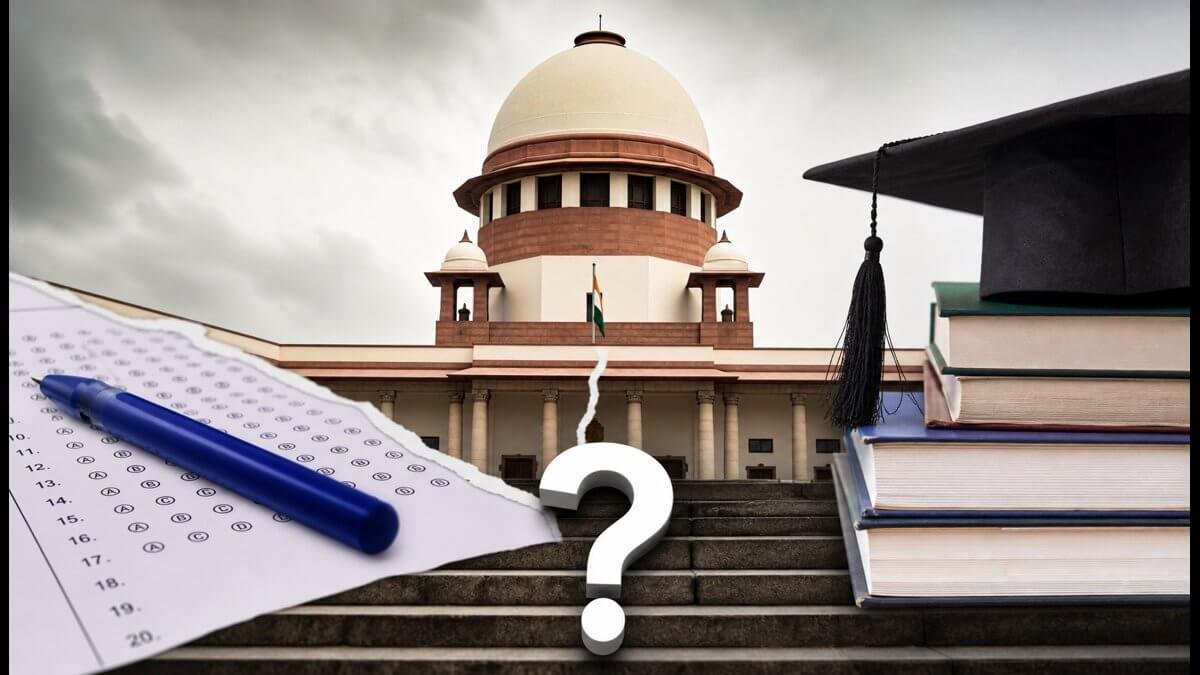
Candidates may seek intervention from the Supreme Court when representations to the examination authority have not produced a reasoned resolution of an answer-key dispute. Such proceedings may request an independent assessment by qualified subject experts, correction or withdrawal of questions with demonstrably defective answers, and recalculation of marks, merit positions, or ranks. Petitioners may also challenge an evaluation method alleged to apply inconsistent standards or produce unequal treatment. Where counselling is imminent, they may seek directions designed to preserve fairness, such as maintaining relevant records, disclosing the review process, or taking protective measures while the dispute is considered.
Article 14 of the Constitution, which embodies equality and protection against arbitrary state action, is relevant to public examinations conducted by statutory or public authorities. Its principles require comparable candidates to be treated consistently and decisions to have a rational basis. However, the existence of a disputed question does not automatically establish a constitutional violation. A challenge generally needs to show more than disagreement with an answer; it should identify material error, irrationality, unequal application of the rules, or a process that was procedurally unfair.
Courts ordinarily exercise caution in academic matters. They commonly defer to properly constituted expert committees and avoid substituting judicial opinion for specialist academic judgment. Intervention is more likely where the accepted answer is demonstrably unsustainable, relevant material has been ignored, the authority has acted arbitrarily, or the review procedure lacks basic fairness. An expert-led reconsideration may therefore be more realistic than a request for the Court to determine a subject answer directly.
A petition should be supported by the provisional or final answer key, question papers, objections and replies, candidate representations, applicable examination rules, and authoritative textbooks, guidelines, or other expert literature. It should identify the correct examination authority and necessary respondents, explain the relief sought, and address any request for interim protection. Filing a petition does not itself prove that the answer key is wrong, require postponement of counselling, or guarantee a change in scores or ranks. Those outcomes depend on the evidence, the authority’s process, and the Court’s assessment of urgency and legal merit.
The controversy may produce several outcomes, depending on the strength of the objections and the examination authority’s review. The objections could be rejected, leaving the original answer key, scores, ranks, eligibility thresholds, and counselling schedule unchanged. Alternatively, specific answers may be corrected, or disputed questions may be deleted. In that event, the authority may apply a uniform marking rule, such as awarding marks to all candidates for an invalid question, rather than benefiting only those who selected a particular option.
A revised result or rank list could follow if the changes materially affect scores. Even a small number of questions may influence admission prospects where candidates are closely ranked. Revised marks could alter eligibility for counselling, preferred specialties, institutional choices, and seat allotments. The effect will depend on the number of affected questions, their marks, the distribution of responses, and the candidate’s position near a cutoff or preference boundary. A court or authority could also direct a fresh expert review, potentially delaying counselling while preserving the process until a reasoned decision is issued.
legal-grounds-and-the-supreme-court-route Candidates should preserve their response sheets, the original answer key, objection records, and all official notices. They should note each disputed question, selected response, claimed correct answer, and supporting source, preferably using authoritative textbooks, guidelines, or institutional references. Objection fees, submission formats, and petition deadlines should be followed precisely. Candidates should monitor verified updates from the examination authority and courts, rather than relying solely on unofficial rankings,(NEET PG 2026 answer key dispute) social-media posts, or forwarded messages.
The dispute also highlights wider requirements for examination governance. Transparent answer-key review, consistent expert standards, documented reasoning, timely communication, and clear correction procedures can protect individual candidates while maintaining confidence in national postgraduate medical admissions. Any remedy should address genuine errors without creating unequal treatment or avoidable disruption to counselling and seat allocation.