




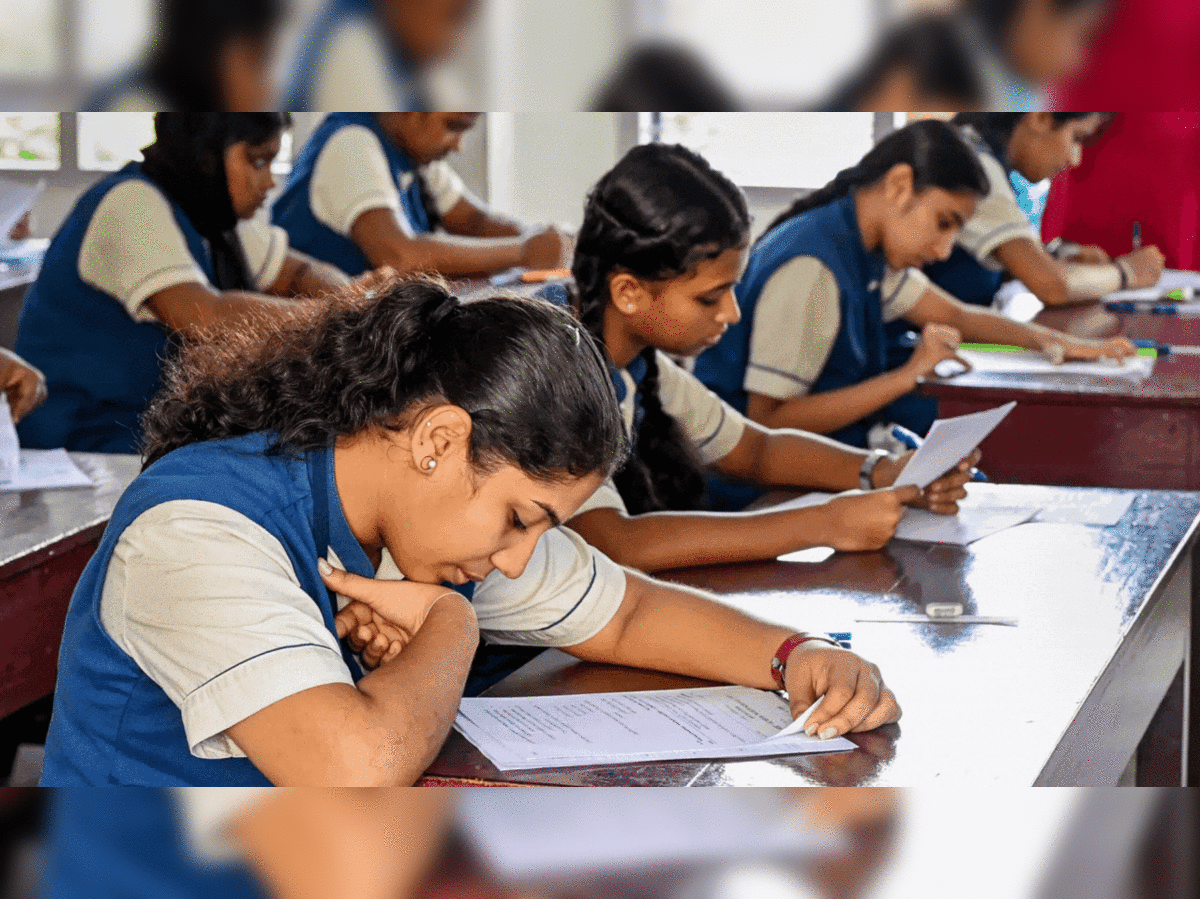
The Central Board of Secondary Education (CBSE) is a prominent educational body in India, responsible for regulating and overseeing the nation’s school curricula. As the education landscape evolves, it is essential for such organizations to implement timely reforms that address contemporary learning needs. In this context, the CBSE has recently introduced significant reforms for the 2025-26 academic session aimed at modernizing the educational approach and making it more relevant to current and future societal demands.
Among the reforms introduced, the allowance of basic calculators in Class 12 Accountancy stands out as a pivotal change. This decision reflects an understanding of the challenges that students face in traditional assessment methods. By permitting calculators, the CBSE aims to reduce the cognitive load on students, allowing them to focus on applying accounting principles rather than merely performing calculations. This shift acknowledges the increasing reliance on technology in the field of finance and accountancy, preparing students for real-world applications where such tools are commonplace.
Additionally, the CBSE is set to roll out a digital evaluation system that modernizes the assessment methodology. This transition from paper-based evaluations to a more digitized process signifies a move towards efficiency and accuracy in grading. Such advancements not only streamline the evaluation process but also promote transparency and accountability in academic assessment. The implementation of these reforms highlights the CBSE’s commitment to fostering an educational environment that is adaptable and aligned with international standards, ensuring students are equipped with the necessary skills for a rapidly changing world.
Overall, the introduction of these reforms by the CBSE signifies a comprehensive effort to enhance the learning experience, ensuring that students are better prepared for higher education and professional opportunities. These changes represent a significant step forward in reshaping the educational framework for future generations.
Use of Basic Calculators in Class 12 Accountancy
The Central Board of Secondary Education (CBSE) has announced a significant reform for the Class 12 Accountancy examinations, allowing students to utilize basic calculators. This move is aimed at enhancing students’ understanding of accounting principles, facilitating more accurate computations during exams, and reducing the cognitive load associated with manual calculations. Permitted calculators are expected to include models that feature basic arithmetic functions such as addition, subtraction, multiplication, and division, while excluding more advanced functionalities like graphing or programming.
Advocates of this reform argue that the introduction of basic calculators can yield several benefits for students. By allowing calculators, students can concentrate on mastering the conceptual aspects of accounting rather than getting bogged down in lengthy calculations. It allows them to approach questions more confidently and focus on analytical thinking, thereby fostering a deeper comprehension of accounting practices. Educational experts suggest that this change is particularly relevant in the context of the evolving educational landscape, where technology integration is increasingly becoming essential for student engagement and learning outcomes.
However, this reform has not been without its share of concerns and criticisms. Opponents argue that the use of calculators could lead to a dependency that undermines the foundational skills necessary for future financial problem-solving. They fear that students may become reliant on technology, compromising their ability to perform basic calculations without digital assistance. Additionally, educators stress the importance of ensuring that students maintain proficiency in manual calculations to develop their analytical skills effectively.
In light of these discussions, it becomes evident that while the introduction of basic calculators presents promising advantages, it is imperative to strike a balance to ensure that students develop a robust understanding of accounting principles alongside their technical skills. The overall aim is to enhance educational outcomes without compromising foundational competencies.
Digital Evaluation System: Overview and Benefits
The Central Board of Secondary Education (CBSE) is set to implement a pioneering digital evaluation system for the academic session 2025-26, aimed at transforming the way student assessments are conducted. This initiative leverages cutting-edge technology to facilitate a more efficient and streamlined evaluation process. The digital evaluation system utilizes sophisticated software and algorithms that allow for the accurate assessment of student performance, significantly reducing human error in marking.
One of the primary components of this reform is the integration of specific digital tools that enhance the evaluation process. These tools include online examination platforms that support automated evaluation, enabling quicker grading of answer scripts. The system is designed to be user-friendly, allowing teachers and evaluators to efficiently navigate through the software while scoring students. This modernization of assessments aligns with the latest trends in global education, where digital formats are increasingly becoming the norm. By adopting this system, CBSE is not only improving its internal processes but also setting a benchmark for educational institutions worldwide.
The benefits of the digital evaluation system are manifold. First and foremost, it increases efficiency; evaluators can process a large volume of answer sheets in a fraction of the time required for traditional methods. Accuracy is another crucial advantage—algorithms can consistently apply grading criteria, ensuring that every student is assessed fairly. Additionally, this reform enhances transparency in assessments, as results can be generated more systematically, providing students and educators with access to detailed reports that outline performance metrics. Overall, the introduction of the digital evaluation system signifies a substantial leap forward in student assessments, promising a more equitable and comprehensive approach to education.
Impact on Students and Educational Outcomes
The introduction of key reforms by the Central Board of Secondary Education (CBSE) for the 2025-26 academic session is expected to significantly transform educational experiences for students. Specifically, the allowance of basic calculators in Class 12 Accountancy is set to ease the cognitive load on students, enabling them to concentrate more on understanding concepts rather than solely on manual calculations. This shift aligns with the evolving needs of a technology-driven society, wherein the proficiency in utilizing digital tools becomes essential for academic success.
Furthermore, the implementation of digital evaluation is poised to enhance the overall assessment experience. It aims to streamline the grading process, ensuring timely feedback while also providing students with a clearer understanding of their strengths and areas for improvement. Such advancements in evaluation methods are anticipated to foster deeper engagement among students, leading to improved retention of knowledge and better academic performance. Testimonials from educators highlight a positive outlook on this transformative approach, noting increased student motivation and a more interactive learning environment.
This transition is not just about academic efficiency; it reflects a broader shift in the educational paradigm. Students will likely develop crucial skills such as digital literacy and problem-solving, which are increasingly imperative in today’s job market. Teachers and administrators have observed that these reforms could encourage a culture of collaborative learning, wherein students can leverage technology to facilitate group projects and research. The potential long-term effects on the education system in India include a generation of learners who are not only academically proficient but also well-prepared to navigate their future careers in an increasingly complex digital landscape.
Through these reforms, CBSE is decidedly paving the way for a more modern educational framework, ultimately aiming to better prepare students for the challenges and opportunities that lie ahead.