





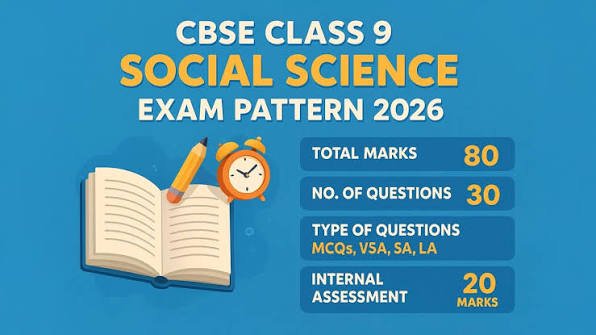
CBSE Class 9 Social Science is designed to assess students’ understanding of society, the past, places and resources, government, and economic life. The subject generally brings together four related areas: History, Geography, Political Science, commonly taught as Civics, (CBSE) and Economics. A guide to the examination pattern can help students see how these strands may be assessed and how preparation should extend beyond memorising facts. It also clarifies the terms used to describe the marks, so that subject-wise distributions in later sections are easier to interpret.
Assessment usually has two broad components: a written examination and school-based internal assessment. The written paper tests learning through questions set for an examination, while internal assessment may draw on work completed during the school year, such as projects, activities, assignments or other school-approved tasks. The precise activities, weightings and methods of recording performance are not necessarily identical in every setting. They may depend on the CBSE curriculum and assessment directions in force, as well as how the school implements those requirements.
CBSE For clarity, written-paper marks means the marks allocated to the formal written examination. Internal-assessment marks refers to marks awarded through the school-based assessment component. Total subject marks means the combined maximum for the subject when those components are added, where the applicable scheme requires that calculation. These labels describe different parts of an assessment; they should not be treated as confirmed numerical allocations for 2027. Students and families should check the latest official CBSE curriculum, relevant assessment circulars and their school’s instructions before relying on any marks distribution, question count, duration or paper format. Until those sources confirm the details, examples of a possible pattern are guidance only, not a final statement of the 2027 examination arrangements.
Subject-wise marks distribution across the four disciplines
CBSE For the 2026–27 academic session, students should distinguish the syllabus’s subject-wise weightage from the marks available in the final written examination. A topic’s prescribed teaching time or curriculum emphasis does not automatically establish how many marks it will receive in the school’s annual paper. Nor should a familiar pattern from an earlier year be assumed to apply unchanged.
Unless the current CBSE curriculum and assessment documents explicitly confirm a subject-wise allocation, exact marks for History, Geography, Political Science and Economics cannot be stated reliably. The distribution should therefore be treated as unconfirmed rather than filled in with estimates. Check the prescribed Class 9 Social Science curriculum and the examination blueprint or assessment plan issued by your school. These are the appropriate sources for the applicable written-paper total, internal assessment arrangements, and any discipline-wise allocation used for your examination.
Each discipline assesses a different range of knowledge and reasoning. History generally asks students to understand events, developments, causes and consequences, and to interpret chronology and historical sources. Geography develops understanding of physical and human environments, spatial relationships, geographical terms and, where specified, map-based skills. Political Science focuses on constitutional ideas, democratic institutions, rights, responsibilities and civic reasoning. Economics examines foundational concepts and how they apply to everyday choices, production, livelihoods and wider economic activity.
These descriptions indicate the kinds of learning students should prepare for; they do not establish fixed marks for particular skills. For example, map work may be included when the curriculum or school blueprint provides for it, but students should not assume a specific number of map marks without official guidance. Similarly, source interpretation, explanations and application questions may appear in different forms or proportions. Use the syllabus to identify prescribed content, then follow your school’s published assessment plan for the paper structure and subject-wise marks. If the school has not provided a breakdown, ask the Social Science teacher rather than relying on unofficial tables or previous years’ formats.
When reviewing a CBSE Class 9 Social Science question paper, begin by checking the total marks and allotted time. These details indicate how much time students can reasonably spend on each response and help them plan revision and exam strategy. Next, examine how the paper is organized: it may group questions by subject, skill, or response format, but the arrangement should be confirmed from the official 2027 sample paper or a school-issued blueprint. Do not assume a fixed number of sections, questions, or marks for any part of the examination.
Read the instructions carefully to identify whether all questions are compulsory, whether internal choices are provided, and how students should record answers. The paper may include objective items, short-answer responses, and longer written questions. Case- or source-based tasks may also appear, but their presence, structure, and mark values should be checked against the relevant official or school guidance. The same applies to any stated word limits, choice rules, or requirements to answer questions in a particular sequence.
Map-based assessment deserves specific attention. Geography map work may ask students to locate, identify, or label features included in the prescribed syllabus. A History-related map component should be expected only if it is specified in the syllabus, sample paper, or school blueprint; it should not be presumed to follow the same requirements as Geography. Students should practise using maps accurately and follow the paper’s instructions on marking locations or presenting answers.
Social Science assessments commonly use sources, data, visuals, or real-world situations to test interpretation and application, alongside recall of key facts and concepts. For example, students may need to draw an inference from a passage, read information in a chart, interpret an image, or apply a concept to a scenario. These are common assessment approaches, not guaranteed components of the 2027 paper unless confirmed by the applicable materials. Reviewing those materials closely gives students a more reliable picture of question formats and helps them prepare for both factual and analytical responses.
Internal assessment can complement the written examination by recognising learning demonstrated throughout the year, rather than relying only on performance in a final paper. Depending on the current CBSE curriculum and school policy, it may involve periodic tests, projects, subject-enrichment activities, portfolio work, or assessment of notebooks and classwork. These activities can help students build subject knowledge, practise research and communication, and receive feedback while there is still time to improve. The specific components and their contribution to a Class 9 result should not be assumed: check the applicable official curriculum and school instructions, since requirements can vary by subject or session.
For preparation, give regular attention to all four Social Science disciplines—History, Geography, Political Science and Economics—instead of concentrating on one area just before the examination. Make concise revision notes that capture key concepts, examples, dates and cause-and-effect relationships. Use timelines to organise historical developments and practise map work wherever it is prescribed. In answers, respond directly to the question and match the detail to the marks available: a short response needs a clear point, while a higher-mark answer may require several explained points or supporting examples. Practise interpreting sources, tables, charts and other data, and review official sample questions or question formats when they are published.
To confirm the 2027 pattern, use a short verification checklist: consult the CBSE curriculum for the 2026–27 session; check any official assessment guidance, sample questions or other examination publications released for that session; and ask the subject teacher or review the school’s examination notice for the applicable paper format and internal-assessment tasks. Confirm subject-wise marks, duration, question types, map requirements and any project or portfolio deadlines directly from these sources. Class 9 examinations at school level may follow the CBSE curriculum, but the precise paper blueprint is often issued or adapted by the school. Treat older patterns and unofficial online summaries as provisional until the relevant documents and school instructions are available.