
CBSE has issued an update on the practical examination arrangements for the 2027 board cycle, including an advance schedule for schools in winter-bound regions. This timing is distinct from the practical-examination window followed by other affiliated schools, (CBSE) so the two schedules should not be treated as interchangeable. The advance arrangement is intended for eligible winter-bound schools and reflects the need to complete examinations before local weather and school-calendar conditions become more restrictive.
The notice concerns the applicable assessment activities for students in Classes X and XII, including practical examinations and, where specified, project work and internal assessment. The exact components can vary by class, subject and the instructions set out in the circular. Students should therefore avoid relying on general summaries, informal messages or dates shared for another school category. A schedule for a regular school may not apply to a winter-bound institution, and the reverse may also be true.
No individual examination date, subject-specific schedule or submission deadline should be assumed unless it appears in the latest official CBSE circular or is confirmed by the school. Students and parents should check the circular carefully for the schools it covers, the relevant class and assessment component, and any directions about conduct, records or evaluation. They should also follow communications issued by their own school, which can provide the confirmed timetable and practical arrangements for each subject.
Schools should communicate the applicable schedule to students and ensure that candidates understand which assessments are included. If a circular is revised or clarified, the latest official version should take precedence over earlier notices. Checking both CBSE’s official communication and the school’s instructions is the safest way to establish the correct dates and requirements. This is particularly important for winter-bound schools, because their practical-examination window may begin earlier than the window used by other schools. Confirming details directly helps students prepare without confusing separate schedules or relying on unverified information.
Winter-bound schools face conditions that can make a standard practical examination window difficult to manage. In regions where temperatures fall sharply, snowfall, icy roads, and disrupted transport may prevent students, teachers, or external examiners from reaching school reliably. Severe weather can also lead to shortened school days or temporary closures, interrupting access to laboratories, equipment, and supervised assessment facilities. These risks are especially important for practical subjects, where students must attend in person and complete work under observation. An earlier schedule gives schools more opportunity to conduct assessments while travel and campus operations remain manageable, rather than relying on a narrow period when weather disruptions may be more likely.
Completing practical examinations before the winter break also helps schools protect time for essential administrative work. Teachers need to assess performance, verify records, and ensure that marks and related documents are accurate before submission. If assessments are postponed until after a closure or break, schools may have less time to arrange examiner visits, reschedule affected students, and resolve missing or incomplete entries. Planning an advance window can therefore provide a practical buffer: schools can finish experiments, projects, viva voce examinations, and other required components while students and staff are available. It also reduces the risk that a local closure will leave practical work unfinished as the reporting deadline approaches.
This earlier arrangement applies to practical assessments and should not be confused with the theory examination calendar. Practical dates are organized around school readiness, regional conditions, subject requirements, and the board’s instructions for submitting marks. Theory examinations, by contrast, follow the dates and timetable announced separately for written papers. The two schedules may differ, and completing practical work early does not mean that theory papers are also held earlier at that school. Students and families should check official CBSE notices and school communications for the applicable practical window, reporting requirements, and theory examination dates. Keeping the calendars distinct helps students prepare for each assessment in the correct period and avoids assumptions based on the school’s winter schedule.
Once the practical examination schedule is announced, schools should begin by reading the complete circular rather than relying on headlines or cropped extracts. They should note applicable dates, instructions, reporting windows, examiner arrangements, and any subject-specific conditions. Administrators should compare the published timetable with their academic calendar and identify potential clashes early. If a detail is unclear, they should seek clarification through the appropriate official channel before issuing local directions.
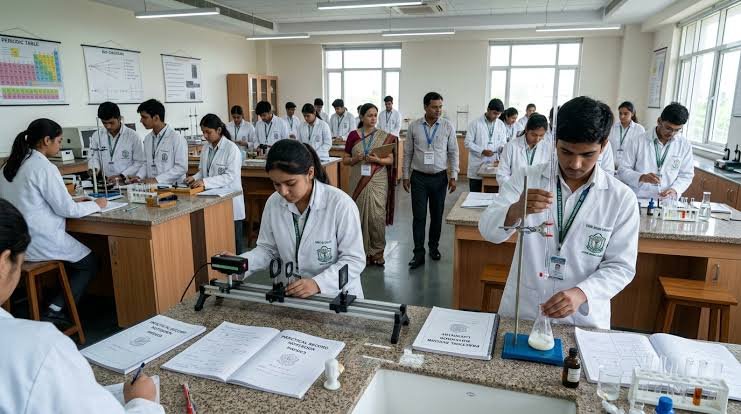
Schools should then confirm subject-wise arrangements, including candidate lists, laboratory availability, and the sequence in which practicals will be conducted. Where external or appointed examiners are involved, the responsible coordinator should verify contact details, dates, arrival expectations, and coordination requirements. Laboratories should be checked for safe, working equipment, necessary materials, and suitable seating. Required records, such as practical files, project work, attendance sheets, and assessment documents, should be organized and accessible.
Students should read their school’s instructions carefully and identify which practical subjects they will be assessed in, along with any required files, records, or projects. They should check that their work is complete and ask teachers promptly about submission requirements, reporting times, equipment to bring, and the assessment format. If an instruction appears different from information shared elsewhere, students should confirm it with the school rather than make assumptions or rely on informal messages.
Examiners and school coordinators should communicate early about the confirmed schedule, subject requirements, assessment procedures, and any logistical needs. Schools should share the final timetable with students and families through established channels, allowing enough time for preparation and noting any updates clearly. Arrangements may differ between schools and subjects, so a timetable circulated informally should not be treated as authoritative. The school’s confirmed arrangements, read alongside current CBSE directions, take precedence over unofficial posts, screenshots, or forwarded messages. Checking the latest official information helps everyone prepare consistently and reduces avoidable confusion as the examination dates approach.
Before practical examinations begin, check that your practical notebook or record is complete, neatly presented, and signed where required. Confirm that projects, models, assignments, or other assessed work are finished and ready to submit. Revise the experiments, procedures, observations, calculations, and safety practices relevant to each subject; for performance-based subjects, practise the required tasks and review assessment criteria. Prepare for the viva by revisiting key concepts, terminology, methods, and the reasoning behind your results. Check attendance requirements with your school, since eligibility and any shortage-related procedures must be confirmed locally. Pack subject-specific materials, such as instruments, equipment, art supplies, calculators, or approved protective clothing, only as directed by your teachers. Ask whether records or projects must be brought on a particular date.
Does an early practical schedule apply to every CBSE school? Not necessarily. Students should not assume that dates announced for winter-bound schools apply to all schools; arrangements can depend on the school category and official CBSE instructions. How can you find your own dates? Request your individual timetable from the school, and check its notices or official communication channels. The school can confirm your reporting time, venue, batch allocation, required documents, and any subject-specific instructions. If a date on a notice appears inconsistent with another message, do not rely on forwarded posts or make assumptions. Contact the examination coordinator or school office promptly, share the notices you have received, and ask which schedule is current. Keep the clarification for reference.
Are theory examination dates affected by practical dates? Practical scheduling does not, by itself, establish a change to the theory timetable. Check the official CBSE date sheet and any later board announcements for confirmed theory dates, and ask the school how practical arrangements fit with your personal schedule. If travel, severe weather, or another local issue could affect attendance, notify the school as soon as possible and follow its directions rather than expecting an automatic change. For policy updates, rely on official CBSE communications; for individual dates and logistics, rely on your school’s confirmed instructions. Recheck notices regularly, especially if your school operates in a winter-bound region, and resolve questions early so you can prepare without last-minute uncertainty.