
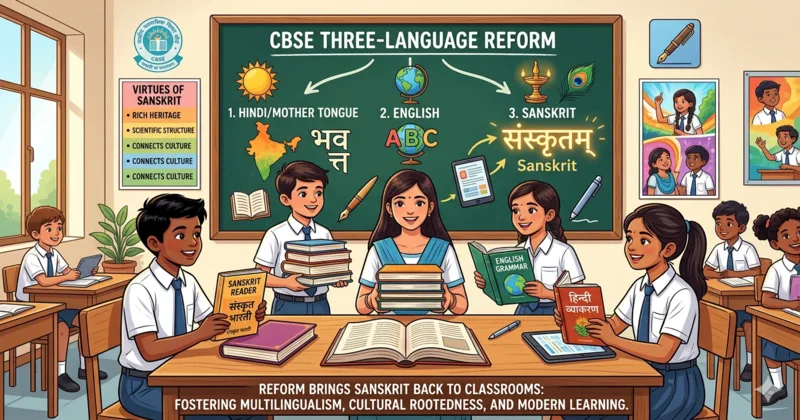
Sanskrit The Central Board of Secondary Education (CBSE) introduced the Three-Language Formula as a pivotal educational policy aimed at promoting linguistic diversity and enhancing cultural appreciation among students in India. Primarily, the formula mandates students to learn three languages during their schooling years: two languages that are recognized as Indian languages and one foreign language. This initiative is rooted in fostering a multilingual environment that reflects India’s rich tapestry of languages and cultures.
The primary objective of the CBSE Three-Language Formula is to ensure that students acquire proficiency in multiple languages, thereby equipping them with critical communication skills that are essential in today’s globalized world. By encouraging students to study Indian languages, the formula aims to preserve and promote the country’s linguistic heritage, which is an integral component of its national identity. The inclusion of a foreign language also enhances students’ global perspective, preparing them for international opportunities.
Historically, the evolution of language education in India under the CBSE can be traced back to the country’s post-independence era when there was a burgeoning emphasis on national integration and cultural enrichment. Initially, the focus was on vernacular languages; however, the introduction of the Three-Language Formula in the 1960s marked a significant shift towards a structured approach in multilingual education. The formula was designed to address the challenges of linguistic imbalances across different states and regions, ensuring that students can communicate effectively across various cultural contexts.
In conclusion, the CBSE Three-Language Formula serves not only as an educational guideline but also as a vital strategy to encompass the linguistic variety of India and promote a sense of unity among its diverse population. By encouraging the study of multiple languages, the framework seeks to cultivate a generation that appreciates its heritage while being poised to engage with global advancements effectively.
The Growing Importance of Language Skills in the Age of AI
In an era dominated by artificial intelligence (AI), the ability to communicate effectively and adaptively has become increasingly crucial. Language skills play a vital role in equipping individuals with the necessary tools to thrive in a landscape where AI technologies characterize many professional sectors. The rising demand for skilled professionals who can navigate the complexities of human-machine interaction highlights the need for robust language proficiency.
Research indicates a strong correlation between language learning and cognitive development, underscoring that students who engage with multiple languages, including classical ones like Sanskrit, can enhance their critical thinking abilities and creativity. Engaging with diverse languages fosters greater flexibility in thought processes, allowing individuals to approach problems from various perspectives—an attribute that is invaluable in an AI-driven workforce where innovative solutions are paramount.
Moreover, understanding languages such as Sanskrit, which has a rich grammatical structure and extensive vocabulary, can significantly improve analytical skills. The rigorous study of classical languages demands attention to detail and logical reasoning, cultivating a disciplined approach to learning that translates well into various fields, including technology and science. As industries evolve and new roles emerge, the traditional linguistic competencies will become a unique advantage, allowing professionals to stand out in a competitive job market.
Additionally, multilingualism is increasingly viewed as a key skill in the global economy. Being proficient in multiple languages enhances communication in multicultural teams, which is especially relevant as companies seek to leverage diverse perspectives in problem-solving. The continuous evolution of AI technologies necessitates skilled workers who can engage in meaningful discussions about ethical considerations and implications, further emphasizing the importance of language skills.
Sanskrit: A Language for the Future?
Sanskrit, often referred to as the ancient language of India, possesses unique features that may serve as significant assets in the era of artificial intelligence (AI). One of the most remarkable aspects of Sanskrit is its structured and systematic nature, which enables clear communication and precise expression. This precision can be extremely beneficial when delving into programming languages and computational linguistics, as these disciplines demand a high degree of clarity and algorithmic thinking.
The grammatical rules of Sanskrit make it an exemplary model for understanding syntax and semantics, which are central components of modern programming paradigms. The inherent logical structure of the language can help learners develop a robust foundation in the principles of computational reasoning. As students become adept in Sanskrit, they may find parallels in the syntax of various programming languages, thereby enhancing their coding skills and adaptability in fields such as software development.
Moreover, the relevance of Sanskrit extends to artificial intelligence, particularly in domains like natural language processing (NLP) and machine learning. Language models trained on well-defined linguistic structures, like those of Sanskrit, can facilitate the development of AI systems that understand and process human languages more effectively. Recent initiatives and research have demonstrated that digital Sanskrit lexicons are being created, contributing to advancements in AI that leverage the precision and richness of the language.
Furthermore, the revival of interest in Sanskrit can foster interdisciplinary collaborations that bridge traditional knowledge with modern technological innovations. By harnessing the strengths of this ancient language, students may not only acquire valuable skills but also contribute to the evolution of AI technologies that are linguistically and culturally sensitive. This fusion of tradition and modernity positions Sanskrit as a potentially formidable asset in preparing students for the challenges of the future workforce.
Implementing Sanskrit within the CBSE curriculum presents both significant challenges and valuable opportunities that educators and institutions must navigate. One of the primary challenges is resource availability. Many schools may lack access to adequate learning materials or instructional resources that cater specifically to Sanskrit. This can hinder the effective teaching of the language and limit student engagement. Furthermore, the scarcity of qualified teachers proficient in Sanskrit can pose a considerable barrier to successful implementation, as effective instruction relies heavily on educators who not only understand the language deeply but can also instill enthusiasm for it in their students.
Another challenge lies in student interest. Modern educational trends tend to prioritize languages that have wider applicability in the global market, such as English and Hindi. Consequently, Sanskrit often struggles to attract attention from students who may view it as less relevant. Addressing this perception is critical, as fostering interest in Sanskrit requires innovative teaching methods that highlight its relevance to contemporary issues, such as its philosophical contributions to artificial intelligence ethics.
Conversely, the opportunities associated with integrating Sanskrit into the curriculum are noteworthy. Incorporating Sanskrit can foster a greater understanding of cultural diversity among students, enhancing their multicultural awareness. It can also serve to improve cognitive skills through the study of its complex grammar and syntax, which can be beneficial in developing analytical abilities.
Moreover, leveraging technology can further facilitate the language learning process. Digital platforms and language-learning apps can be instrumental in providing students with engaging ways to learn Sanskrit, catering to different learning styles and preferences. Schools that have successfully implemented Sanskrit programs demonstrate positive outcomes, showing that with the right resources and strategies, students can thrive in their learning of this ancient language. Overall, the journey toward integrating Sanskrit into the CBSE framework is rife with obstacles but also rich with potential that, when harnessed effectively, can greatly enhance students’ educational experiences.