
After Winning Nobel Prize in Medicine, Karl Deisseroth Teaches Stanford UG Class On Optogenetics
Nobel Prize 2026 winner Karl Deisseroth’s return to Stanford to teach his undergraduate class has gone viral, with one user commenting, “Won a Nobel prize and still went to teach undergrads. That’s the dream.”
After Winning Nobel Prize in Medicine, Karl Deisseroth Teaches Stanford UG Class On Optogenetics
After Winning Nobel Prize in Medicine, Karl Deisseroth Teaches Stanford UG Class On Optogenetics
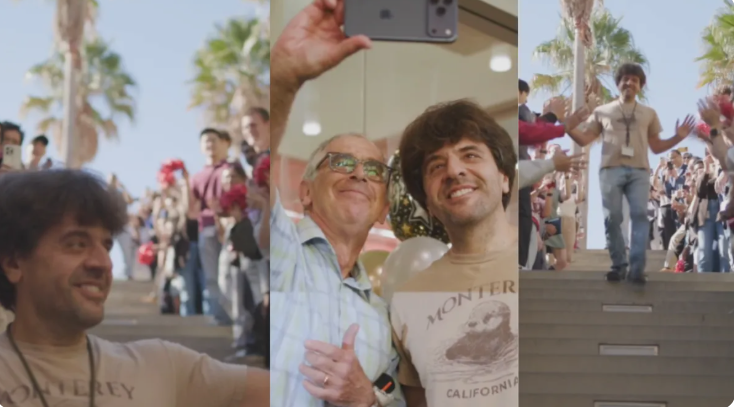
Karl Deisseroth, winner of the 2026 Nobel Prize in Medicine or Physiology, also went viral on social media after videos capturing his and his family’s reaction to the big news surfaced online. Now, another video of him being welcomed by the students and faculty of Stanford’s Shriram Center is being loved for the support and affection he received at the university.
“We love you. We love your work,” said fellow faculty member Russ Altman, who’s known Karl since 1992, during the welcome at Stanford.
Karl is a Professor of Bioengineering with a joint appointment in the Department of Psychiatry and Behavioral Sciences at Stanford. He is also an investigator at the Howard Hughes Medical Institute.
Karl Teaches His Class On Optogenetics, His Award-Winning Research
Karl was welcomed by the entire bioengineering community as he entered the Stanford premises to teach his undergraduate class on “Principles and Practice of Optogenetics for Optical Control of Biological Tissues.”
“Won a Nobel prize and still went to teach undergrads. That’s the dream,” one user commented on the video shared by Stanford’s official X account.
“Get back to work. We have a lot of things still to discover and a lot of people to help,” this was Karl’s way of celebrating, as he said shortly after his win.
“Wisdom, devotion to your work, seriousness of purpose, sense of humor, and then your status as a father, husband, physician. What a model,” fellow faculty member Russ Altman said.
Karl was the youngest at 54 among the three researchers who won the Nobel in Medicine or Physiology and made a breakthrough in the neuroscience world by proving that light can switch on and off a brain cell.
He was the last to join Peter Hegemann, 71, and Georg Nagel, 73. At first, he started with his own group as he began to search for a protein that could trigger electrical impulses in nerve cells.
He later reached Georg Nagel and asked for access to the DNA encoding the protein and experimented with the same in rat nerve cells. In 2005, his findings were published.
Karl’s Family Reaction That Went Viral Across Social Media
“Dad, you’ve won all the prizes!” said Karl’s Daughter Sophie.
Karl’s mom Louise Deisseroth said he had always been fascinated by nature and that she is very proud of him.
“The natural world was always fascinating to Karl. As a child, he was very interested in everything: watching ants walk along the ground or the waves rolling in at the beach. He was curious about the world and had amazing concentration skills. I was always struck by how much he respected not only learning but also the effort and energy needed to accomplish his goals. I’m just so proud and happy for him,” she said.
Alexander, Karl’s 18-year-old son, a freshman at Stanford University, said “I woke up at 7 a.m. and saw a text from my mom that said, ‘We have news!!’ So I called, and she handed the phone to my dad. He said, ‘I got a call from Stockholm,’ and I immediately knew what was happening. … I came right over. It’s a 5-minute bike ride. We all knew he deserved this, and he’s deserved it for a while. We’re insanely proud of him.”
“I’m just so delighted. I know I’m biased, but he’s really transformed the field of neuroscience – and several other fields too. I’m so proud of him,” said Michelle Monje-Deisseroth, the Milan Gambhir Professor in Pediatric Neuro-Oncology, and Karl’s wife.
Hudson, Karl’s 16-year-old son said, “The word I’d use to describe my dad is relentless. Dad is one of the hardest working people I know – every waking hour he’s giving it all to do everything he needs to. And he had a lot of waking hours. More than most people. He’s always working toward something.
ALSO READ| Nobel Prize in Medicine 2026: How 3 Scientists Used Light To Switch Brain Cells On And Off