







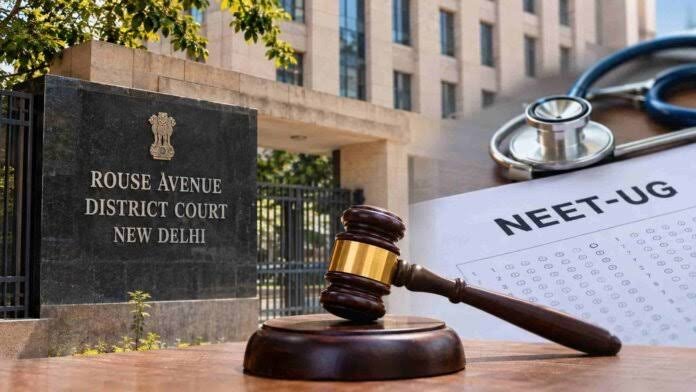
NEET Paper-Leak Case in Delhi: Court Orders Charges to Be Framed Against 14 AccusedThe reported decision to frame charges against all 14 accused means the Delhi court considers there to be sufficient grounds, at this stage, for the case to proceed to trial on specified allegations.(NEET) In criminal proceedings, framing charges is a formal step that identifies the accusations each person must answer. It allows the prosecution and defence to prepare for the trial, where evidence and arguments will be examined. The court’s decision reflects a preliminary assessment of the material before it, not a final determination of what happened.
NEET Importantly, an order framing charges does not establish that any accused person is guilty. The allegations remain to be proved through the trial, and each accused retains the right to contest the prosecution’s case, challenge evidence and present a defence. The prosecution must meet the applicable legal standard before a conviction can be entered. Until then, the matter should be described as a case moving forward against the accused, rather than as proof that they took part in a paper leak or related conduct.
Reports about the NEET paper-leak case may summarize the court’s action, but exact legal details should not be assumed from a headline or general account. The precise court that issued the order, its date, the statutory provisions invoked and the wording of the charges should be checked against the order itself or reliable reporting that quotes or accurately describes it. Those details matter because charges may differ among defendants, and the legal basis can shape the issues at trial. A careful account should distinguish the reported procedural ruling from any later findings. Framing charges marks a transition toward adjudication; it does not resolve the allegations, and the court’s eventual conclusions will depend on the evidence presented and assessed during the proceedings.
The Delhi case concerns allegations of irregularities linked to the National Eligibility cum Entrance Test (NEET), the medical entrance examination taken by students across India. According to the prosecution’s account, a group of people was involved in a plan connected to access to, or circulation of, examination material before the test. The precise route by which any paper was allegedly obtained, the extent of its circulation, and whether it was used by candidates must be treated as matters for evidence, not assumed facts.
Investigators examined the alleged roles of those named in the case and gathered material that was placed before the court. Based on the record presented at this stage, the court ordered charges to be framed against 14 accused. That procedural decision means the case will proceed to trial on specified accusations; it does not establish guilt. The accused retain the right to contest the prosecution’s version, and the allegations must be tested through evidence and legal proceedings.
NEET Public reporting has associated the case with claims of advance access to examination content and arrangements involving people allegedly connected to candidates. However, details should be attributed to investigators or prosecutors unless they have been established in court. The available account does not justify treating every reported step as proven, or asserting that a particular person obtained, transmitted, or benefited from a leaked paper. A distinction between an allegation, evidence accepted for trial, and a final finding is therefore essential.
The case attracted attention because NEET results can shape students’ access to medical education, after years of preparation and substantial family investment. Any suspected compromise raises concerns about fairness for candidates who sat the examination under ordinary conditions, as well as the integrity of a high-stakes national test. The proceedings also matter to families seeking clarity and to the wider public assessing confidence in examination safeguards. The court’s order marks a formal next stage in resolving the accusations, while the question of what occurred remains for trial to determine.
The 14 people named in the case are accused persons, not a group whose members have been found guilty. The court’s decision to frame charges means it considers there to be sufficient grounds for the case to proceed to trial; it is not a finding that the allegations are true. The prosecution must still prove its case against each defendant, and each person is entitled to challenge the evidence and present a defence.
Public accounts of the proceedings describe the case as involving an alleged conspiracy connected to the unauthorised acquisition or circulation of NEET examination material. However, the alleged conduct may not be the same for all 14 people. In cases of this kind, investigators may allege different roles for suspected organisers, intermediaries, people accused of handling or distributing material, and candidates said to have sought an unfair advantage. Those broad categories should not be treated as confirmed descriptions of any particular defendant unless they are specified in reliable court records or attributed reporting.
It is therefore important to distinguish the prosecution’s overall theory from individual allegations. A person’s presence in the charge sheet or inclusion among those facing trial does not, by itself, establish that the person obtained, shared, or used leaked questions. The evidence and the alleged role attributed to each accused must be assessed separately during the proceedings.
The court has ordered charges to be framed against the 14 accused, but the precise offences and statutory provisions should be stated only by reference to the formal charge order or another authoritative record. Without confirmation of those details, listing particular sections of criminal law could misstate what the court has ordered. The framing of charges also leaves the legal issues open for trial, including whether the prosecution can establish the alleged agreement, conduct, and required elements of any offence beyond reasonable doubt.
After charges are framed, each accused is generally asked to respond to them in court. The accused may plead guilty or claim trial. A plea of not guilty means the prosecution must proceed to prove the allegations through evidence and witness testimony. The framing of charges identifies the accusations the trial will address; it is not a finding that any accused person is guilty.
During the prosecution’s evidence stage, witnesses may be called to testify and relevant documents or other material may be placed before the court. The defence can question prosecution witnesses through cross-examination, seeking to test the accuracy, reliability and consistency of their accounts. The court may also consider whether the evidence is admissible and how much weight it should receive. These proceedings can involve multiple hearings, particularly where the case has several accused, witnesses or disputed issues.
NEET Once the prosecution has presented its case, the accused may be given an opportunity to explain circumstances appearing in the evidence, as required by the applicable procedure. The defence may then present evidence of its own, although an accused is not required to prove innocence. After evidence is complete, both sides make submissions on how the law and facts should be assessed. The court ultimately decides whether the prosecution has established each charge beyond a reasonable doubt, the applicable criminal standard. If it has not, the accused must be acquitted; if it has, the court may record a conviction and proceed to sentencing.
Neither the schedule nor the outcome can be inferred from the charge-framing order alone. The pace of a trial depends on factors such as court availability, (NEET) witness attendance, applications by the parties and the complexity of the evidence. Further hearings may therefore take time, and procedural developments can affect the timetable. Readers should follow subsequent court hearings and rely on official orders, court records or careful reporting by credible news organisations for updates. Until the court reaches a verdict, the allegations remain to be tested through the trial process, and the accused are presumed innocent unless proven guilty.