
Every year, millions of medical aspirants across India appear for the National Eligibility cum Entrance Test (NEET) with the dream of securing admission to prestigious medical colleges. However, qualifying for NEET is only the first step. The real deciding factor for admission is the NEET Merit List, which determines a candidate’s rank and eligibility for medical seats.
Understanding how the merit list is prepared, what information it contains, and how it affects the counseling process is essential for every NEET aspirant. Whether you are preparing for MBBS, BDS, AYUSH, or other medical programs, knowing the details of the NEET Merit List can help you make informed decisions during admissions.
In this comprehensive guide, we will explore everything about the NEET Merit List, including its types, preparation process, tie-breaking criteria, counseling implications, and much more.
What Is the NEET Merit List?
The NEET Merit List is an official ranking list prepared based on candidates’ performance in the NEET examination. It includes the names, scores, percentile ranks, and positions of eligible candidates who have qualified for admission to medical and dental courses.

The merit list serves as the foundation for the counseling and seat allocation process. Higher-ranked candidates generally have better opportunities to secure admission to top government medical colleges.
Why Is the NEET Merit List Important?
The merit list plays a crucial role because it:
- Determines a candidate’s rank.
- Helps allocate seats during counseling.
- Establishes eligibility for MBBS and BDS admissions.
- Assists state authorities in preparing state-level rankings.
- Guides admissions to AIQ and state quota seats.
Without the merit list, the admission process would lack transparency and fairness.
Who Releases the NEET Merit List?
The National Testing Agency (NTA) conducts the NEET examination and publishes the All India Rank (AIR) list.
After the declaration of NEET results:
- NTA prepares the overall merit list.
- The Medical Counseling Committee (MCC) uses the list for All India Quota (AIQ) counseling.
- State counseling authorities prepare separate state merit lists based on NEET scores.
This ensures a smooth admission process for candidates across the country.
Types of NEET Merit Lists
Many students assume there is only one merit list. In reality, several types of merit lists are used during the admission process.
1. All India Rank (AIR) Merit List
The AIR merit list includes all candidates who appeared for and qualified in NEET.
Key features:
- Prepared by NTA.
- Applicable across India.
- Used for All India Quota counseling.
- Determines national ranking.
2. All India Quota (AIQ) Merit List
The AIQ merit list is used for admissions under the 15% All India Quota seats in government medical colleges.
Benefits include:
- Opportunity to secure admission outside the home state.
- Access to top medical institutions nationwide.
3. State Merit List
Each state prepares its own merit list based on NEET scores.
Characteristics:
- Used for 85% state quota seats.
- Includes domicile candidates.
- Separate counseling process conducted by states.
4. Category-Wise Merit List
Separate merit lists are prepared for reserved categories such as:
- SC
- ST
- OBC
- EWS
- PwD
These lists ensure reservation benefits are provided according to government norms.
Information Included in the NEET Merit List
The merit list contains several important details about candidates.
Candidate Information
Typically, the list includes:
- Candidate name
- Roll number
- Application number
- NEET score
- Percentile score
- Category
- All India Rank
- Category rank
Candidates should carefully verify all details after publication.
How Is the NEET Merit List Prepared?
The preparation of the NEET Merit List follows a systematic process.
Step 1: Evaluation of Answer Sheets
NTA evaluates candidate responses using standardized procedures.
Step 2: Score Calculation
Marks are awarded according to the NEET marking scheme:
- Correct answer: +4 marks
- Incorrect answer: -1 mark
- Unanswered question: 0 marks
Step 3: Percentile Calculation
Candidates receive percentile scores based on their relative performance.
Step 4: Ranking
Ranks are assigned according to the total marks obtained.
Step 5: Merit List Publication
The final merit list is released after all calculations and verifications are completed.
NEET Merit List Tie-Breaking Criteria
Sometimes two or more candidates obtain the same score. In such situations, NTA follows tie-breaking rules.
First Preference
Candidates with higher marks in Biology are ranked higher.
Second Preference
If the tie continues, Chemistry marks are considered.
Third Preference
Candidates with higher Physics scores receive preference.
Fourth Preference
A random selection process may be applied if the tie still remains unresolved according to prevailing guidelines.
These rules help maintain fairness in ranking.
Difference Between NEET Result and NEET Merit List
Many students confuse these two terms.
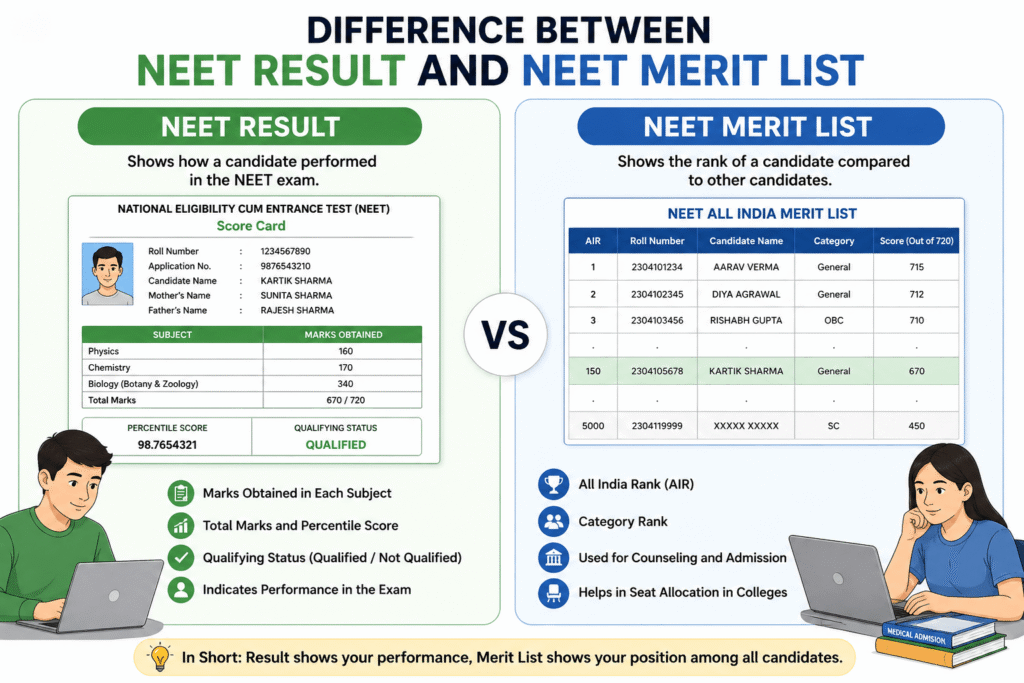
NEET Result
The result shows:
- Candidate score
- Percentile
- Qualification status
NEET Merit List
The merit list shows:
- Ranking position
- Admission eligibility
- Counseling priority
In simple terms, the result reflects performance, while the merit list determines admission opportunities.
How to Check the NEET Merit List
Candidates can access the merit list online after it is officially released.
Steps to Check
- Visit the official NEET website.
- Click on the merit list link.
- Download the PDF file.
- Search using roll number or application number.
- Verify rank and other details.
It is advisable to keep multiple copies for future counseling purposes.
Role of NEET Merit List in Counseling
The merit list directly impacts the counseling process.
Seat Allocation
Counseling authorities allocate seats based on:
- Merit rank
- Category
- Reservation criteria
- College preferences
- Seat availability
Better Rank Means Better Opportunities
Candidates with higher ranks generally have:
- More college options
- Higher chances of government college admission
- Better course selection flexibility
Thus, rank plays a significant role in determining future academic opportunities.
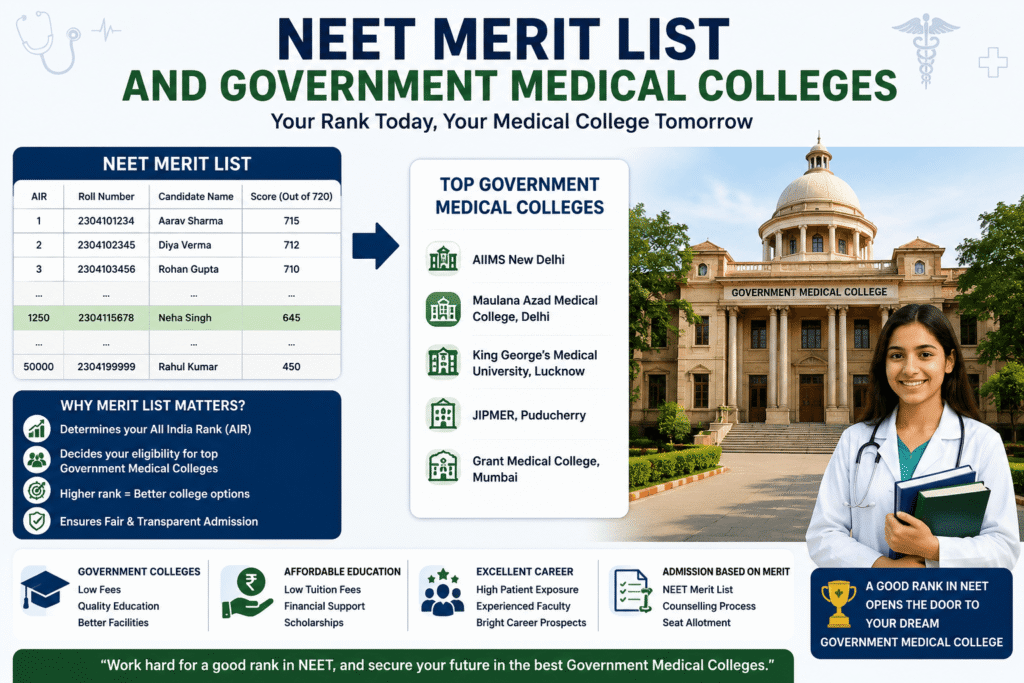
NEET Merit List and Government Medical Colleges
Admission to government medical colleges is highly competitive.
Importance of Rank
A strong merit rank can help candidates secure admission to:
- Government MBBS colleges
- Government BDS colleges
- Premier medical institutions
- AIIMS campuses
- Top state medical colleges
As the number of applicants increases every year, competition becomes more intense.
State Merit List vs All India Merit List
Understanding the difference between these two lists is important.
All India Merit List
- Prepared by NTA.
- Covers all qualified candidates.
- Used for AIQ counseling.
State Merit List
- Prepared by state authorities.
- Includes eligible domicile candidates.
- Used for state quota admissions.
A candidate may have different rankings in both lists.
Factors Affecting Your Position in the NEET Merit List
Several factors influence your ranking.
Examination Difficulty Level
A tougher paper can affect score distribution.
Number of Candidates
Higher participation increases competition.
Candidate Performance
Overall performance across India impacts percentile calculations.
Reservation Policies
Category-based reservations influence admission opportunities.
Understanding these factors helps candidates analyze their standing realistically.
Common Mistakes Students Make Regarding the Merit List
Many students make avoidable errors during the admission process.
Ignoring State Merit Lists
Some candidates focus only on AIR and overlook state counseling opportunities.
Missing Counseling Deadlines
Even with a good rank, missing deadlines can result in losing admission opportunities.
Not Researching Colleges
Students often fail to explore all available options before counseling.
Incorrect Documentation
Missing or incorrect documents may create admission difficulties.
Being prepared can prevent these issues.
Tips to Improve Your NEET Rank
Although the merit list is prepared after the examination, future aspirants can improve their rank by following effective strategies.
Focus on NCERT
Most NEET questions are NCERT-based.
Practice Mock Tests
Regular mock tests improve:
- Accuracy
- Time management
- Confidence
Strengthen Biology
Biology carries the highest weightage in NEET.
Analyze Previous Year Papers
Understanding question patterns helps boost preparation.
Maintain Consistency
Daily study habits often produce better results than occasional intensive sessions.
Documents Required During Counseling
Candidates should keep essential documents ready.

Important Documents
- NEET scorecard
- Admit card
- Class 10 certificate
- Class 12 mark sheet
- Identity proof
- Category certificate (if applicable)
- Domicile certificate
- Passport-size photographs
Proper documentation ensures a smooth counseling process.
Future of Medical Admissions Through NEET
NEET has streamlined medical admissions across India by creating a uniform evaluation system.
Advantages include:
- Transparency
- Fair competition
- Standardized assessment
- Equal opportunities
The NEET Merit List remains one of the most important components of this process, helping deserving students secure medical seats based on merit.
Conclusion
The NEET Merit List is much more than a ranking document—it is the foundation of the entire medical admission process. From determining your All India Rank to influencing counseling outcomes and college selection, the merit list plays a decisive role in shaping your medical career.
Understanding how the merit list is prepared, the different types of rankings, tie-breaking rules, and counseling procedures can give candidates a significant advantage during admissions. Therefore, students should stay informed, monitor official announcements, and participate actively in counseling rounds.
If you’re preparing for NEET or awaiting counseling results, keep track of the latest updates, verify your rank carefully, and make informed choices to maximize your chances of securing admission to your preferred medical college.