



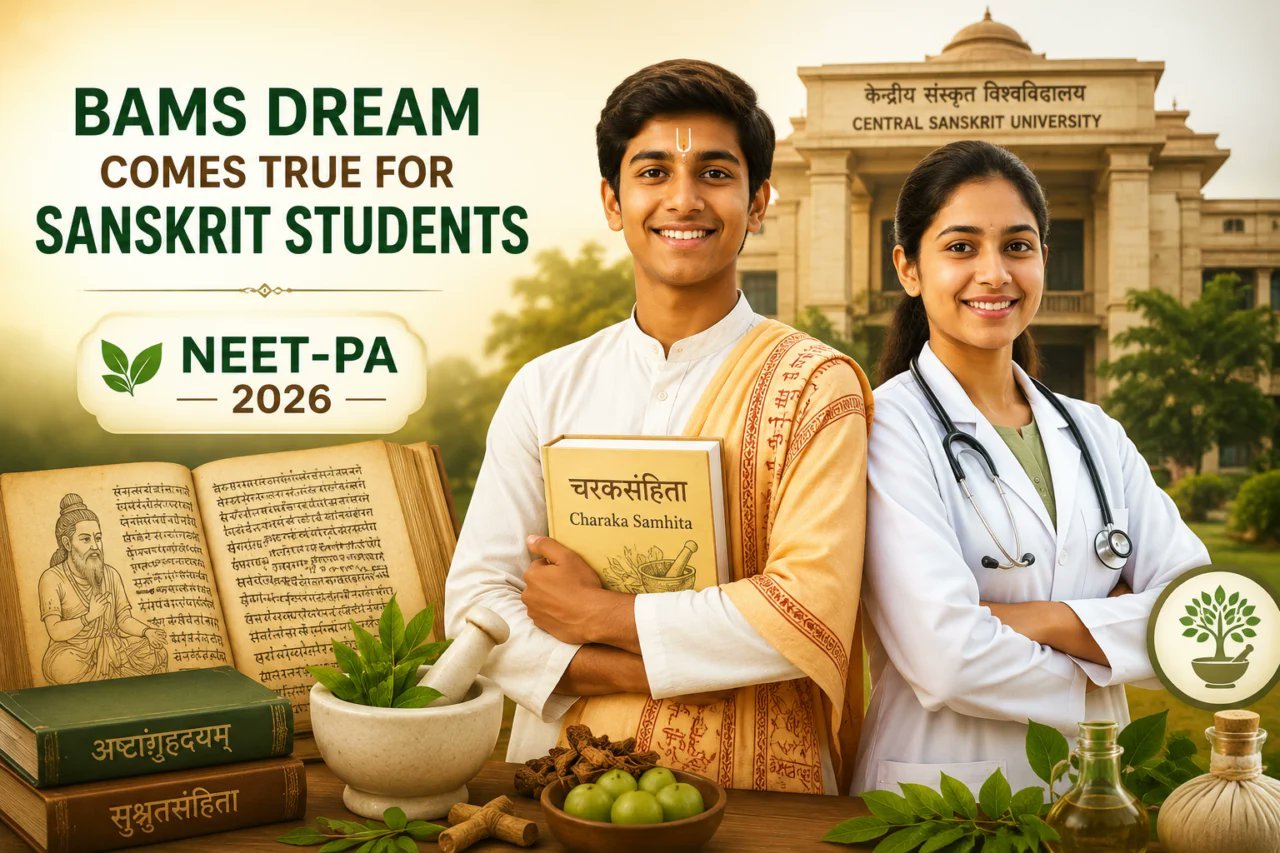
NEET-PA The National Eligibility cum Entrance Test for Postgraduate Ayurveda, commonly known as NEET-PA, has been introduced by the Central Sanskrit University as a pivotal initiative aimed at providing Sanskrit scholars with a novel pathway into the realm of Bachelor of Ayurvedic Medicine and Surgery (BAMS). This entrance test is particularly significant as it acknowledges the unique background of students who have cultured their knowledge within the frameworks of Sanskrit education.
Unlike traditional NEET examinations, which are primarily focused on mainstream science subjects like Physics, Chemistry, and Biology, NEET-PA is tailored to better suit the academic strengths of Sanskrit scholars. Its structure is designed to assess candidates’ proficiency in Ayurveda, a field intricately linked with the rich textual and philosophical tradition of Sanskrit literature. This shift is not merely a logistical adjustment; it signifies a broader recognition of Ayurveda’s importance and the need for specialized pathways that honor the heritage of these students.
The objectives of NEET-PA extend beyond mere admission into the BAMS program. They encompass the desire to elevate the status of Ayurveda and enrich it with scholars who are not only well-versed in modern medical practices but also have a deep understanding of traditional Ayurvedic texts. This blending of knowledge is essential in cultivating practitioners capable of bridging ancient wisdom with contemporary healthcare challenges. Furthermore, it hopes to encourage more students from diverse educational backgrounds to consider a future in Ayurveda, ultimately contributing to the field’s growth and diversification.
In conclusion, NEET-PA represents a landmark opportunity for Sanskrit students to engage with Ayurveda on a higher level while acknowledging and valuing their linguistic and cultural backgrounds. This initiative stands to reshape the educational landscape for aspiring Ayurvedic practitioners, fostering a new generation that is both literate in Sanskrit traditions and proficient in modern medicine.
The Impact on Ayurveda Education and Sanskrit Scholars
The introduction of the National Entrance Test for Postgraduate Ayurveda (NEET-PA) marks a significant turning point in Ayurveda education, particularly for students who possess a strong foundation in Sanskrit. Historically, individuals trained in Sanskrit have been underrepresented in the medical fields, including Ayurveda, often due to systemic barriers and the lack of transparency in admission processes. As a result, many proficient Sanskrit scholars found it challenging to pursue Bachelor of Ayurvedic Medicine and Surgery (BAMS) programs, despite their extensive knowledge of ancient texts and Ayurvedic principles.
The implementation of NEET-PA is set to rectify this disparity by providing a standardized platform for aspiring Ayurvedic practitioners. This entrance test not only evaluates candidates fairly but also encourages those with a background in Sanskrit, thereby unlocking new opportunities for these students. By recognizing the unique skills that these scholars bring to the field, NEET-PA can contribute to a more diverse and comprehensive educational landscape in Ayurveda.
Enhancing access to BAMS programs through standardized testing aligns with the broader goal of integrating traditional knowledge with modern medical practices. It facilitates a smoother transition for Sanskrit scholars into an academic environment that has long been perceived as inaccessible. Consequently, this fusion of skill sets can lead to enriched practices in Ayurveda, where the depth of knowledge rooted in Sanskrit complements contemporary methodologies.
Furthermore, by diversifying the student pool within Ayurveda, NEET-PA aids the preservation and continuation of Sanskrit literature associated with Indian medicine. As the educational landscape evolves, it is imperative to harness the talents of those who have historically remained on the periphery. This initiative not only empowers aspiring students but also enhances the professional community by weaving together traditional and modern approaches to healthcare.
Future Prospects: Opportunities for Aspirants in BAMS
The introduction of the NEET-PA by Central Sanskrit University presents a significant turning point for Sanskrit students aspiring to pursue a Bachelor of Ayurvedic Medicine and Surgery (BAMS). This initiative not only opens an academic pathway for these students but also enhances their prospects in a growing field that emphasizes holistic health practices.
Graduates of BAMS can explore a diverse range of career opportunities in various sectors. One of the prominent career paths includes practicing as an Ayurvedic physician, where they can provide patient care, prescribing natural therapies, and devising treatment plans based on traditional Ayurvedic principles. The demand for healthcare professionals specializing in holistic approaches has been on the rise, creating a favorable environment for BAMS graduates.
Moreover, BAMS holders can also contribute to the field of research. With the increasing recognition of Ayurveda’s efficacy in complementary medicine, graduates have the opportunity to engage in research projects that validate and enhance Ayurvedic practices. This not only aids in promoting Ayurveda but also supports the integration of traditional therapies into modern healthcare systems.
In addition to healthcare and research roles, BAMS graduates can opt for careers in education, providing instruction in Ayurvedic philosophy and practice. They can take up roles as educators in academic institutions, contributing to the training of the next generation of Ayurvedic practitioners. Furthermore, as Ayurveda continues to gain popularity globally, there are opportunities for entrepreneurship, where graduates can establish their clinics or wellness centers, catering to a growing clientele interested in alternative medicine.
Overall, the NEET-PA initiative positions Sanskrit students for success in the evolving landscape of healthcare, aligned with a broader trend towards integrating Ayurvedic principles in contemporary medical practices. The future appears promising for those embarking on this journey, as the holistic health movement gains momentum worldwide.
Expert Opinions and Community Reactions
The recent launch of the NEET-PA by Central Sanskrit University has ignited a spectrum of responses from educators, Ayurveda practitioners, and Sanskrit scholars. The initiative, set to pave new pathways for Sanskrit students aspiring to pursue Bachelor of Ayurvedic Medicine and Surgery (BAMS), has been met with excitement and cautious optimism within the community.
Dr. Anjali Sharma, a prominent educator in the field of Ayurveda, expressed her enthusiasm, stating that “the introduction of NEET-PA represents a significant step in blending traditional knowledge with modern educational frameworks. It opens doors not only for Sanskrit scholars but also enhances the value of Ayurveda in contemporary healthcare.” Her comments underscore the initiative’s potential to broaden the recruitment pool from which future Ayurveda practitioners may emerge.
Conversely, concerns regarding the NEET-PA implementation were voiced by several scholars. Professor Ramesh Gupta, a Sanskrit academic, highlighted the challenges ahead, remarking, “While the NEET-PA is a promising venture, ensuring that it aligns with the distinct philosophical tenets of Ayurveda is crucial. Striking a balance between standardization and the preservation of Ayurvedic principles must be prioritized.” His insights reflect a broader concern about maintaining the integrity of Ayurvedic education amidst changing frameworks.
Furthermore, Ayurveda practitioner and advocate Ms. Kavita Vinayak stressed the importance of community involvement, stating, “Engagement from Ayurveda professionals in shaping the NEET-PA’s curriculum will be essential for its acceptance. The community must work collectively to ensure that students gain not only theoretical knowledge but also practical skills rooted in our traditions.” Such calls for collaboration highlight the necessity of incorporating diverse perspectives to ensure the NEET-PA’s effectiveness.
In this regard, stakeholders suggest enhancing training programs and addressing potential logistical challenges that could arise as the system is rolled out. By fostering an inclusive dialogue, the NEET-PA can grow to be a robust model that supports Sanskrit students in realizing their aspirations in the field of Ayurveda.